




Why is it in News?
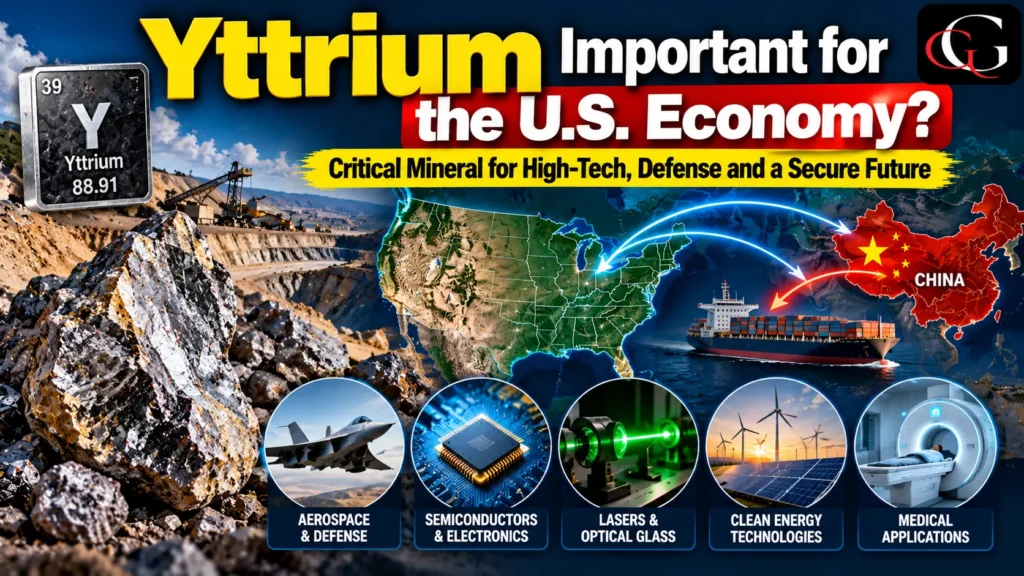
Yttrium, a relatively little-known rare-earth element, has become strategically important for the United States amid disruptions in global critical-mineral supply chains.
In September 2026, U.S. and Japanese officials discussed China’s restrictions on yttrium exports and ways to diversify supplies. The discussions focused on strengthening yttrium and permanent-magnet supply chains because disruptions have affected U.S. and Japanese companies.
Yttrium is particularly important for aerospace, semiconductors, electronics and advanced manufacturing. Reuters reported that China has a dominant position in the supply of yttrium and other strategic materials, prompting companies to explore alternative materials and recycling.
Geographic Overview
Yttrium (Y) is a chemical element with atomic number 39. It is commonly grouped with the rare-earth elements because of its similar chemical properties, although it is not technically a lanthanide. Yttrium is found in association with other rare-earth minerals, particularly in deposits containing xenotime and monazite. Its geographic importance comes less from its absolute scarcity than from the limited number of economically viable deposits and the concentration of processing capacity.
The United States has yttrium-bearing resources, but its domestic supply chain remains limited. According to the 2026 U.S. Geological Survey ‘Mineral Commodity Summaries’, there were no fully commercial U.S. facilities capable of separating or refining yttrium. Yttrium-containing materials are associated with rare-earth mining and heavy-mineral-sand operations in the United States Yttrium has several high-value applications. It is used in ceramics, phosphors, optical glass, fiber optics and lasers, while yttrium-aluminium-garnet (YAG) crystals are used in communication, industrial and medical laser applications.
The U.S. Geological Survey also includes yttrium on its 2025 list of critical minerals, citing its importance in lighting, display technologies and high-performance metal alloys.s.
Why Is Yttrium Geographically Significant?
Yttrium illustrates the importance of critical-mineral geography in modern economies.
The mineral connects three major geographic factors:
Resource location → Processing capacity → Manufacturing centres
Even when a country possesses mineral resources, a shortage of domestic separation, refining and processing capacity can create supply-chain dependence.
For the United States, yttrium is therefore relevant to economic security, advanced manufacturing, aerospace, electronics and technology supply chains. China’s position in rare-earth processing has increased the importance of diversifying sources and developing alternative supply chains.
Frequently Asked Questions
1. What is yttrium used for?
Yttrium is used in ceramics, phosphors, lasers, optical glass, fiber optics and high-performance alloys.
2. Why is yttrium important to the United States?
It supports several advanced industries, while limited domestic refining capacity makes secure supply chains important.
3. Is yttrium a rare-earth element?
Yttrium is commonly classified with rare-earth elements because of its chemical similarities to the lanthanides, although it is not technically a lanthanide.