




Why is it in News?
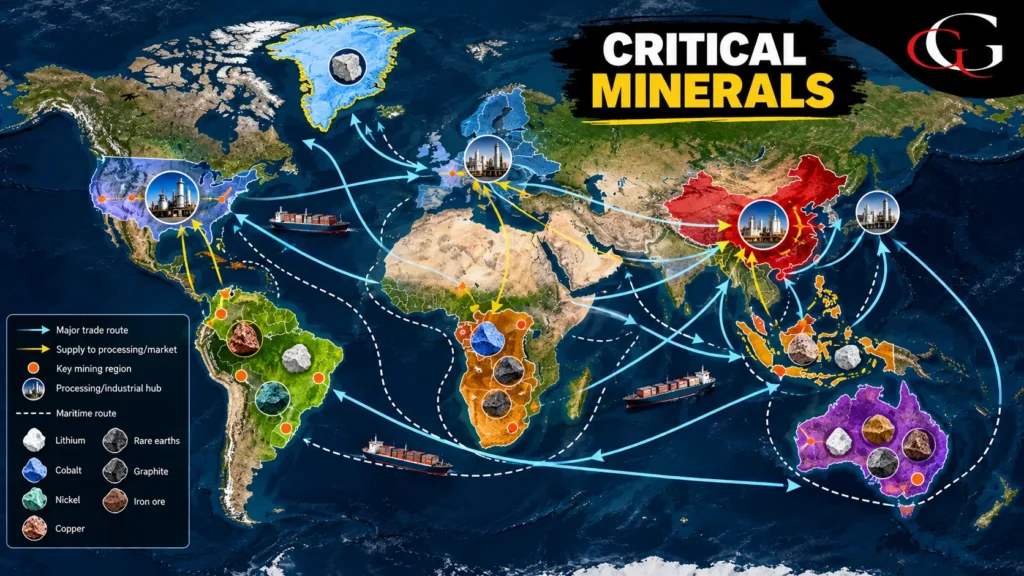
Critical minerals are becoming a major factor in global trade, industrial policy and supply-chain geography. Recent developments involving rare-earth exports, Greenland and U.S.–China trade relations show how mineral resources are influencing where companies source, process and manufacture strategic products.
- China remains dominant in several critical-mineral supply chains. The IEA reports that China accounts for around 70–95% of refining capacity for several key minerals, while its position remains particularly strong in rare-earth processing.
- China’s export controls on several critical minerals and rare earths have increased concerns among the United States, Europe and Japan about supply-chain concentration. A further set of controls is scheduled to face review in November 2026
- Greenland is becoming a new geographical focus. The EU announced a €200 million package in September 2026 aimed partly at developing Greenland’s critical raw-material sector and connecting it with European supply chains.
- According to UNCTAD, demand is rising rapidly while supply remains concentrated. In 2025, the DRC produced 74% of global cobalt, Indonesia 67% of nickel and China 69% of rare-earth mine production.
About Critical Minerals and the Changing Geography of Trade
Critical minerals are minerals that are important for modern industries, energy systems, advanced technology and economic security. Important examples include lithium, cobalt, nickel, graphite, copper and rare-earth elements.
The geography of trade is changing because the important question is no longer simply “Where are minerals mined?” but also “Where are they processed and converted into industrial products?”
- Mining geography: Major mineral-producing regions include Australia, Chile, Indonesia, the Democratic Republic of Congo, China and South America.
- Processing geography: A relatively small number of countries dominate refining and processing. This creates a geographical concentration between the location of mines and the location of industrial processing.
- Technology connection: Critical minerals are required for EV batteries, wind turbines, power grids, semiconductors, smartphones, data centres and advanced defence systems.
- New trade corridors: Countries are increasingly trying to connect mineral-rich regions with alternative processing and manufacturing centres. Greenland’s mineral potential, for example, is attracting greater European and North American attention.
- Trade policy: UNCTAD reports that nearly 100 new export measures affecting critical energy-transition minerals have been introduced since 2020, including licensing requirements, export taxes and bans.
- Recycling and diversification: Countries are investing in recycling, domestic processing and alternative suppliers to reduce dependence on highly concentrated supply chains. The IEA expects recycling to become increasingly important toward 2040.
Sources: S & P Global, IEA, UNCTAD
Frequently Asked Questions
1. What are critical minerals?
They are minerals considered essential for important economic, technological or strategic applications and vulnerable to supply disruption.
2. Which country dominates rare-earth processing?
China remains the dominant country in rare-earth refining and processing, although the United States, Australia, Malaysia and other countries are expanding alternative capacity.
3. Why is Greenland important for critical minerals?
Greenland has significant mineral potential, including rare-earth resources, and its location between North America and Europe makes it geographically relevant to emerging trans-Atlantic supply chains.


