




Why is it in News?
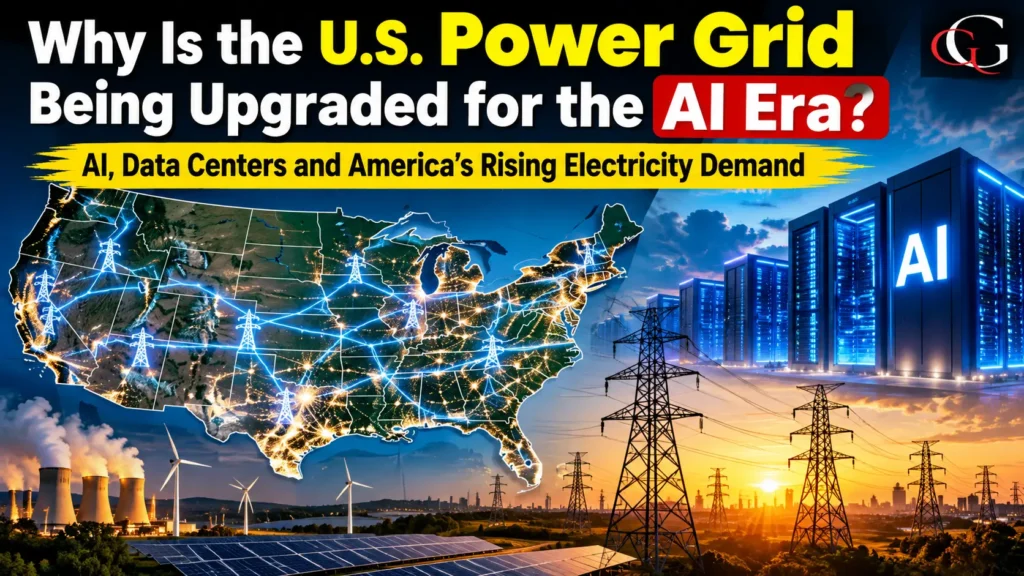
The United States is rapidly upgrading its electricity transmission network as AI, data centers, manufacturing and electrification push electricity demand higher.
On 24 September 2026, the U.S. Department of Energy (DOE) announced plans to support 31 grid-improvement projects across 26 states under its SPARK (Speed to Power) initiative. The projects represent $5.25 billion in total investment, including $1.9 billion in federal funding, and are expected to improve electricity infrastructure serving about 100 million Americans.
The projects are expected to:
- Rebuild or reconductor more than 1,500 miles of transmission lines
- Deploy grid-enhancing technologies across nearly 21,000 miles
- Make more than 23 GW of additional electricity capacity available.
The timing is significant because U.S. electricity demand is entering a period of renewed growth. The U.S. Energy Information Administration (EIA) expects electricity generation to reach a record 4,368 billion kWh in 2026, with another increase expected in 2027. It identifies data-center development and manufacturing as important drivers, particularly in the West South Central region.
What is Driving the Need for a Bigger U.S. Power Grid?
1. AI data centers consume enormous amounts of electricity
Modern AI systems require large numbers of high-performance processors operating continuously. Consequently, the data centers supporting AI applications can require substantial and concentrated electricity supplies.
EIA projects that electricity consumption by data-center servers could reach 446–818 billion kWh by 2050, depending on how quickly computing capacity and electricity demand grow. This makes electricity availability an increasingly important factor in the geography of data centers.
2. Electricity demand is growing after years of relative stability
U.S. electricity demand was relatively flat for much of the 2000s and 2010s. EIA says demand increased about 1.7% annually between 2020 and 2025, compared with only about 0.1% annually from 2005–2019. Data centers are one of the important contributors to this renewed growth.
EIA expects U.S. electricity consumption to continue increasing through 2050, with data-center server energy use playing a major role.
Why Does the Grid Need Upgrading?
The U.S. electricity system consists of a huge interconnected network of:
Power plants → Transmission lines → Substations → Distribution networks → Consumers
Many parts of this infrastructure were designed for electricity-demand patterns that existed before today’s hyperscale data centers. The challenge is therefore not simply generating more electricity. The electricity also needs to be transported from where it is generated to where new demand is emerging.
DOE’s National Transmission Needs Study identifies additional transmission infrastructure as an important requirement for accommodating new large electricity loads, new generation and congestion relief.
What is SPARK?
The SPARK initiative is a U.S. Department of Energy program designed to accelerate improvements to the transmission network. Two important approaches are:
Accelerated Reconductoring
Existing transmission lines can sometimes be upgraded by replacing their conductors with newer, higher-capacity conductors rather than constructing an entirely new corridor.
Grid-Enhancing Technologies
These technologies can improve the ability of existing transmission infrastructure to carry electricity and manage flows more efficiently. The September 2026 projects are expected to make more than 23 GW of additional electricity capacity available.
Geographic Significance
1. Changing industrial location
Historically, industries often located near raw materials, transportation networks or markets. For AI infrastructure, electricity availability and grid connectivity are becoming increasingly important location factors.
2. New energy corridors
Growing electricity demand can require new or upgraded transmission corridors connecting power-generation regions with major demand centers.
3. Regional differences
The impact is not uniform across the United States. Areas experiencing rapid data-center development can face much greater pressure on local generation, transmission and distribution systems.
4. Link between physical and human geography
The issue connects:
Physical Geography: energy resources, climate and water availability
Economic Geography: industrial and data-center location
Human Geography: population and electricity demand
Technology Geography: AI and digital infrastructure
Transport/Infrastructure Geography: transmission corridors
Frequently Asked Questions
Q 1. Why do AI data centers consume so much electricity?
AI data centers operate large numbers of high-performance computing systems continuously. Cooling systems, networking equipment and other infrastructure also require electricity, making large AI facilities significant electricity consumers.
Q 2. What is the U.S. SPARK initiative?
SPARK is a U.S. Department of Energy initiative aimed at accelerating transmission upgrades through measures such as reconductoring and grid-enhancing technologies. In September 2026, DOE announced support for 31 projects across 26 states.
Q 3. How is AI changing energy geography?
AI is making reliable and abundant electricity an increasingly important factor in the location of data centers. This can influence where new infrastructure, power generation and transmission networks are developed.