




Mica occupies a distinctive position among India’s non-metallic mineral resources. Unlike bulk minerals such as limestone or iron ore, its importance comes primarily from a remarkable combination of physical and electrical properties. Mica can be split into extremely thin sheets, remains flexible after splitting, withstands high temperatures and acts as an excellent electrical insulator. These characteristics have made it useful in electrical and electronic equipment, thermal insulation, rubber, plastics, paints, drilling fluids and other specialised industries.
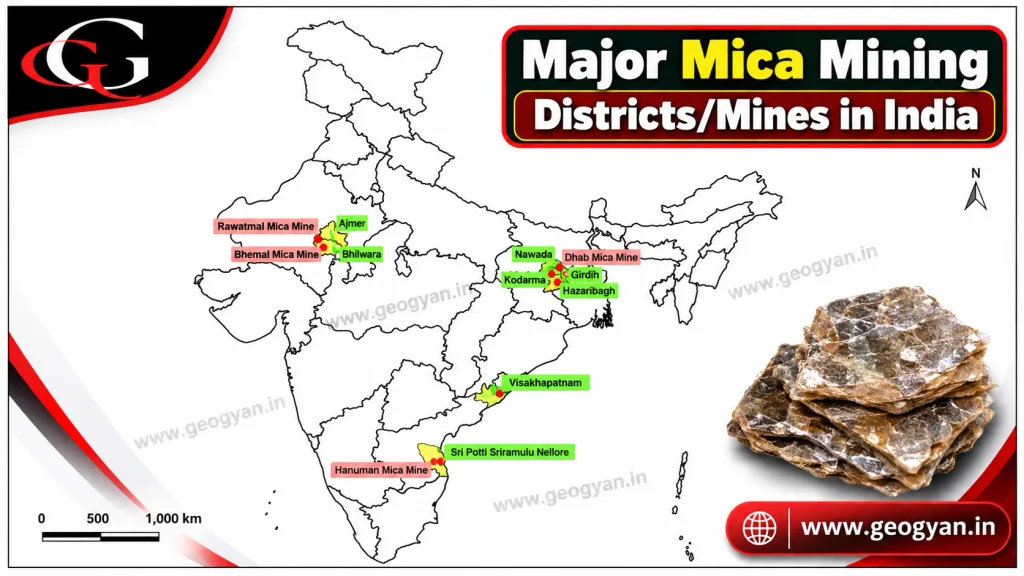
From a geographical perspective, India’s mica deposits are closely associated with ancient crystalline rocks and mica-bearing pegmatites. Important occurrences are concentrated in parts of Andhra Pradesh, Rajasthan, Jharkhand, Bihar, Odisha, Maharashtra and Telangana. The Nellore mica belt of Andhra Pradesh and the historically important Koderma–Giridih–Hazaribagh belt of the Jharkhand–Bihar region are particularly significant.
The resource distribution of mica, however, should not be confused with present-day production. The detailed national resource assessment commonly cited by the Indian Bureau of Mines (IBM) is based on the National Mineral Inventory position as of 1 April 2015. In that assessment, Andhra Pradesh accounted for about 41% of India’s reported mica resources, followed by Rajasthan, Odisha and Maharashtra. More recent IBM state reviews continue to record mica occurrences and resource shares, while the regulatory framework changed significantly in February 2025, when mica was moved from the minor-mineral category to the major-mineral category.
What is Mica?
Mica is not a single mineral but a group of sheet-forming phyllosilicate minerals. Its crystal structure consists of thin, layered sheets, which explains its characteristic ability to split along one dominant plane.
The commercially important varieties include muscovite and phlogopite. Muscovite is commonly referred to as white or potash mica, whereas phlogopite is generally known as magnesium or amber mica. The Indian Bureau of Mines notes that the mica group contains numerous phyllosilicate minerals and that the commercially important varieties have distinctive physical and industrial properties.
The most characteristic property of mica is its perfect basal cleavage. This allows a large mica crystal to be divided into exceptionally thin sheets without losing its basic structural integrity.
Physical Properties of Mica
The industrial value of mica is closely related to its physical properties.
Perfect cleavage allows mica to be separated into thin sheets and films. Its flexibility and elasticity enable these sheets to withstand bending. Mica also has good thermal resistance, making it suitable for applications involving heat. Its high dielectric strength and electrical insulating properties make it particularly valuable in electrical and electronic industries.
Some varieties are sufficiently transparent for specialised applications, while powdered mica retains a characteristic platy structure that makes it useful as a filler in several industrial products.
These properties together make mica different from most other non-metallic minerals and explain its continuing importance despite relatively modest production volumes.
Geological Formation and Occurrence of Mica
Mica occurs in igneous, metamorphic and, in some cases, sedimentary geological environments. However, economically important mica deposits in India are strongly associated with pegmatitic rocks, particularly granitic pegmatites.
Pegmatites are extremely coarse-grained igneous rocks that can contain large crystals of quartz, feldspar and mica. Some pegmatites may also contain economically significant rare and critical minerals.
Muscovite-bearing Pegmatites
Muscovite, the principal variety associated with India’s traditional sheet-mica industry, is commonly found in granitic pegmatites. The large crystals developed in these pegmatites can be extracted as sheets or processed into smaller forms.
Phlogopite
Phlogopite is generally associated with magnesium-rich metamorphic environments and can occur in metamorphosed sedimentary rocks affected by granitic or pegmatitic intrusions.
Distribution of Mica in India
India’s mica occurrences are concentrated mainly in the Peninsular and eastern crystalline regions, where ancient geological formations and pegmatite belts provide favourable conditions for mica formation.
According to IBM, the principal mica-bearing states include Andhra Pradesh, Bihar, Jharkhand, Maharashtra, Odisha, Rajasthan and Telangana. Mica occurrences have also been reported from several other states, including Gujarat, Haryana, Karnataka, Kerala, Tamil Nadu and West Bengal.
1. Andhra Pradesh: The Nellore Mica Belt
Andhra Pradesh is one of India’s most important mica-bearing states. The state’s significance is particularly associated with the Nellore mica belt, which has historically been known for high-quality sheet mica.
IBM’s Indian Minerals Yearbook 2024 states that Andhra Pradesh accounted for approximately 41% of India’s mica resources in the resource assessment cited for the state. The 2024 State Review identifies Nellore and Visakhapatnam as the state’s principal districts for mica occurrences.
The Nellore region is associated with mica-bearing pegmatites occurring within the ancient crystalline terrain of southeastern India. The area’s long history of mica extraction has made it one of the most frequently mentioned mica belts in Indian Geography textbooks.
Important areas:
- Nellore
- Visakhapatnam
2. Jharkhand: The Historic Koderma–Giridih Belt
Jharkhand has a long association with India’s mica industry. The Koderma–Giridih–Hazaribagh region became particularly famous for high-quality sheet mica and played an important role in India’s historical mica exports.
Geologically, this region forms part of the ancient crystalline terrain of the Chota Nagpur Plateau, where pegmatitic bodies occur within the surrounding metamorphic and igneous rocks.
Important areas:
- Koderma
- Giridih
- Hazaribagh
3. Bihar: The Nawada Region
Mica occurrences in Bihar are particularly associated with Nawada district. The geological continuity between southern Bihar and the adjoining Jharkhand terrain makes the Bihar mica region part of the broader eastern Indian pegmatite belt.
The Nawada–Koderma–Gaya region is therefore important for understanding the geographical continuity of mica-bearing rocks across the Bihar–Jharkhand region.
4. Rajasthan: Ajmer and Bhilwara
Rajasthan is another important mica-bearing state. IBM records mica occurrences in Ajmer and Bhilwara, while contemporary mining and environmental-clearance records also document leases where mica occurs along with quartz and feldspar.
This association is important because mica is frequently mined or recorded together with quartz and feldspar, particularly in pegmatitic environments. Consequently, a mining lease described as a Quartz–Feldspar–Mica Mine should not be interpreted as a mica-only mine.
Important areas:
- Ajmer
- Bhilwara
5. Odisha
Odisha contains significant mineral diversity, although mica is not one of its principal production commodities.
The latest IBM State Review identifies Sonepur district as an area where mica occurs. The state is also notable for its extensive Precambrian crystalline geological terrain, which provides favourable geological settings for several non-metallic and metallic minerals.
IBM’s 2024 State Review reports that Odisha accounted for approximately 17% of India’s mica resources in the cited resource assessment.
Important area:
- Sonepur
6. Maharashtra
Mica occurrences in Maharashtra are reported particularly from Sindhudurg district. IBM’s 2024 State Review lists mica among the minerals occurring in the district.
The occurrence of mica in this region is related to the crystalline geological framework of the western part of the state.
Important area:
- Sindhudurg
7. Telangana
Telangana is also recognised as a mica-bearing state. Mica occurs in association with pegmatitic bodies within parts of the state’s crystalline terrain.
Although Telangana is not generally described as one of India’s dominant mica-producing regions, its inclusion among the principal mica-bearing states is important when studying the overall geographical distribution of the mineral.
Other States with Mica Occurrences
Mica occurrences have also been reported from several other parts of India, including:
- Gujarat
- Haryana
- Karnataka
- Kerala
- Tamil Nadu
- West Bengal
These occurrences are generally less prominent in the traditional national mica belts than those of Andhra Pradesh, Rajasthan and the Jharkhand–Bihar region.
Major Mica-Bearing Regions of India
| State | Major mica-bearing area | Geographical significance |
| Andhra Pradesh | Nellore | Major historical mica belt |
| Andhra Pradesh | Visakhapatnam | Mica occurrence |
| Jharkhand | Koderma–Giridih–Hazaribagh | Historic sheet-mica belt |
| Bihar | Nawada | Important eastern mica region |
| Rajasthan | Ajmer | Mica-bearing pegmatite region |
| Rajasthan | Bhilwara | Mica with quartz and feldspar |
| Odisha | Sonepur | Documented mica occurrence |
| Maharashtra | Sindhudurg | Documented mica occurrence |
| Telangana | Pegmatite-bearing areas | Mica-bearing crystalline terrain |
Source: Indian Bureau of Mines, Indian Minerals Yearbook and state reviews.
Mica Resources in India
The state-wise distribution in that assessment was approximately:
| State | Share of reported mica resources |
| Andhra Pradesh | 41% |
| Rajasthan | 28% |
| Odisha | 17% |
| Maharashtra | 13% |
| Bihar | 2% |
| Jharkhand & Telangana | Smaller reported quantities |
Important: These figures represent the cited resource assessment, not current production shares. They should therefore not be used to claim that Andhra Pradesh currently produces 41% of India’s mica.
Production of Mica in India
Mica production statistics require a different approach from resource statistics.
For many years, mica was classified as a minor mineral. Because of this classification, production information was collected through state-level mechanisms and was not available in the same comprehensive reporting framework used for major minerals.
As a result, IBM’s older publications noted limitations in compiling a complete all-India mica production series.
For example, IBM’s historical state-wise data reported:
| State | 2017–18 | 2018–19 | 2019–20 |
| Andhra Pradesh | 15,217 tonnes | 18,360 tonnes | 16,822 tonnes |
| Rajasthan | 6,459 tonnes | 17,000 tonnes | 16,000 tonnes |
A Major Change in 2025: Mica Becomes a Major Mineral
One of the most important recent developments in India’s mica sector occurred on 20 February 2025.
The Ministry of Mines issued S.O. 924(E), under which Barytes, Felspar, Mica and Quartz were removed from the list of minor minerals and brought into the category of major minerals. The change took effect from 20 February 2025.
The Ministry explained that quartz, feldspar and mica commonly occur in pegmatite rocks, which can also host critical minerals such as beryllium, lithium, niobium and tantalum. Bringing these minerals under the major-mineral framework is therefore also relevant to systematic mineral exploration and the identification of associated critical minerals.
Industrial Uses of Mica
Mica’s industrial importance comes from the unusual combination of electrical insulation, heat resistance, flexibility and layered structure.
Electrical and Electronic Industry
Electrical applications are among the most important uses of mica. Natural sheet mica can be processed into blocks, splittings and films, while built-up mica products such as micanite are used for insulation.
Mica-based materials have applications in electrical equipment and components where resistance to heat and electricity is required.
High-Temperature Applications
Mica’s thermal stability makes it useful in equipment exposed to elevated temperatures and rapid temperature changes.
Rubber Industry
Ground mica can be used as a filler and functional additive in rubber products. Its platy particles can influence the physical properties of the finished material.
Plastics
Powdered mica is used as a filler in selected plastic products. It can contribute to dimensional stability and certain mechanical properties.
Paints and Coatings
The platy structure of ground mica makes it useful in some paints and coatings, where it can contribute to surface characteristics and durability.
Drilling Industry
Mica can be introduced into drilling fluids to help control lost circulation, particularly where drilling fluids escape through fractures or permeable zones.
Important Facts for Competitive Exams
- Mica is a group of non-metallic phyllosilicate minerals.
- The characteristic property of mica is perfect basal cleavage.
- Muscovite is commonly known as white or potash mica.
- Phlogopite is commonly known as magnesium or amber mica.
- Granitic pegmatites are important hosts of muscovite mica.
- Nellore is an important mica-bearing region of Andhra Pradesh.
- The Koderma–Giridih–Hazaribagh belt is historically associated with India’s mica industry.
- Nawada is an important mica occurrence area in Bihar.
- Ajmer and Bhilwara are important mica-bearing areas of Rajasthan.
- IBM’s cited National Mineral Inventory assessment placed Andhra Pradesh at about 41% of India’s reported mica resources.
- The same assessment reported approximately 28% for Rajasthan and 17% for Odisha.
- These resource percentages are based on the cited assessment and should not be interpreted as current production shares.
- Mica is widely used in electrical and electronic applications because of its insulating properties.
- Natural sheet mica has faced competition from reconstituted mica and substitute materials.
- Mica became a major mineral in India with effect from 20 February 2025.
Important One-Liners
Q1. What type of mineral is mica?
Answer: Mica is a non-metallic mineral group.
Q2. Which mineral group does mica belong to?
Answer: Phyllosilicates.
Q3. What is the most characteristic property of mica?
Answer: Perfect basal cleavage.
Q4. Which variety of mica is known as white or potash mica?
Answer: Muscovite.
Q5. Which variety is known as magnesium or amber mica?
Answer: Phlogopite.
Q6. Which rock is an important host of muscovite mica?
Answer: Granitic pegmatite.
Q7. Which is an important mica belt in Andhra Pradesh?
Answer: The Nellore mica belt.
Q8. Which belt is historically associated with mica in eastern India?
Answer: The Koderma–Giridih–Hazaribagh belt.
Q9. Which districts are important mica-bearing areas of Rajasthan?
Answer: Ajmer and Bhilwara.
Q10. Which state accounted for about 41% of India’s reported mica resources in the cited NMI assessment?
Answer: Andhra Pradesh.
Q11. Which district is an important mica occurrence area in Bihar?
Answer: Nawada.
Q12. Which district is identified by IBM as a mica occurrence area in Odisha?
Answer: Sonepur.
Q13. Which district is an important mica occurrence area in Maharashtra?
Answer: Sindhudurg.
Q14. When did mica become a major mineral in India?
Answer: 20 February 2025. Q15. Why is mica important to the electrical industry?
Answer: Because it provides excellent electrical insulation and has high dielectric strength.