



Why is it in News?
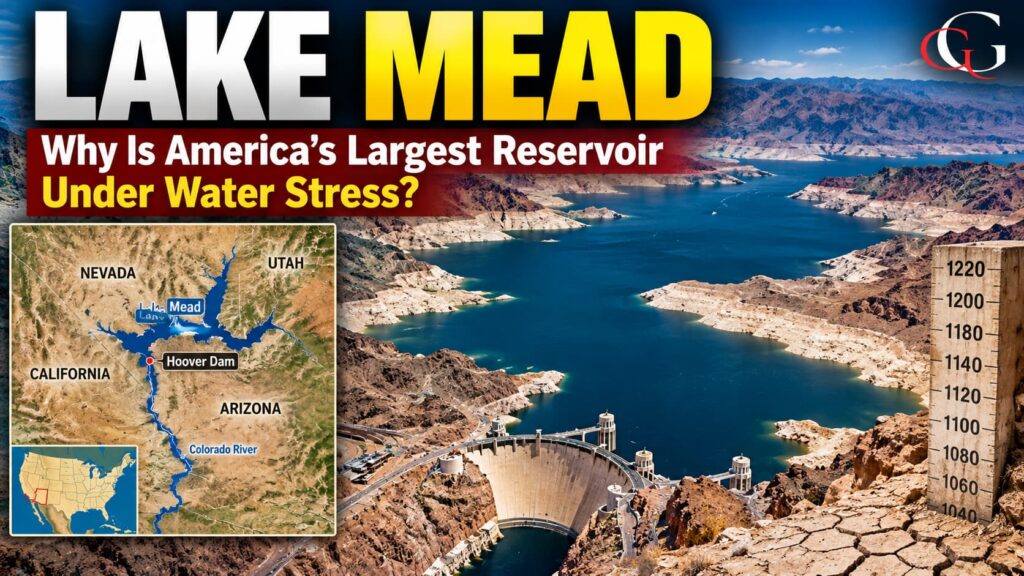
Lake Mead, the giant reservoir behind Hoover Dam on the Colorado River, is again at the center of the U.S. water-supply crisis. In August 2026, the reservoir’s continuing decline and the highly visible “bathtub ring” left by historically higher water levels. The latest U.S. Bureau of Reclamation data show Lake Mead’s elevation at about 1,037.9 feet in early October 2026. The reservoir had fallen steadily through September, from about 1,038.8 feet at the beginning of the month to 1,037.8 feet by September 30.
The decline is particularly important because Lake Mead is a major storage reservoir for the Colorado River, supplying water to communities, agriculture and industries in the southwestern United States.
About Lake Mead
Lake Mead is a man-made reservoir formed by Hoover Dam on the Colorado River. It lies on the border between Nevada and Arizona, southeast of Las Vegas. The Colorado River forms the boundary between the two states in this region.
Hoover Dam was completed in the 1930s, and Lake Mead began filling in 1935. At high water levels, the reservoir can extend roughly 110 miles upstream and has a maximum width of about eight miles. Its maximum storage capacity is around 28.9 million acre-feet under the Bureau of Reclamation’s stated reference elevation.
Lake Mead is more accurately described as a reservoir rather than a natural lake because it was created by damming a river. It is part of a larger system of reservoirs and water infrastructure along the Colorado River.
Why Is Lake Mead Important?
1. Water supply:
Lake Mead is an important source of water for the arid Southwest. Water from the reservoir supports municipal, agricultural and industrial uses in Arizona, California and Nevada
2. Colorado River system:
The reservoir is connected to one of the most important river systems in the western United States. The Colorado River begins in the Rocky Mountains and flows southwest toward Mexico.
3. Hydroelectric power:
Hoover Dam generates hydroelectricity, although the amount of electricity that can be generated is affected by reservoir conditions.
4. Water scarcity indicator:
Lake Mead has become a highly visible indicator of the long-term water challenges facing the American Southwest, where a dry climate, prolonged drought conditions, high water demand and changing hydrology place pressure on the Colorado River system.
Why Is the Water Level Falling?
Several factors are involved. Low inflows, prolonged dry conditions, evaporation and high-water demand all affect the reservoir. Lake Mead also experiences substantial evaporation; the Bureau of Reclamation estimates annual evaporation of roughly 800,000 acre-feet under its reference conditions.
The Colorado River Basin has also experienced a prolonged period of unusually dry conditions. In 2026, federal authorities proposed substantial reductions in Colorado River water use during dry years as the basin continues to face declining supplies. The result is a classic example of water-resource geography: a limited water supply must support cities, agriculture, industries, ecosystems and energy production across a large, predominantly arid region.
Geographic Significance
Lake Mead provides an important case study of the interaction between climate, hydrology, human demand and water-resource management.
Its location in the Mojave Desert makes the reservoir particularly important because natural precipitation is limited. The contrast between the large volume of water stored in the reservoir and the surrounding arid landscape also demonstrates why river-basin management is crucial in dry regions.
The famous white “bathtub ring” around Lake Mead provides a striking visual indicator of previous high-water levels and has become a symbol of the region’s changing water conditions.
Frequentlty Asked Questions
1. Where is Lake Mead located?
Lake Mead is located on the Colorado River along the Arizona–Nevada border, behind Hoover Dam.
2. Why is Lake Mead important?
It is a major water-storage reservoir supporting municipal, agricultural and industrial water use, as well as hydroelectric power and recreation.
3. What is the main reason for Lake Mead’s declining water level?
The decline reflects a combination of low Colorado River inflows, prolonged dry conditions, evaporation and high-water demand rather than a single cause.