


Why is it in News?
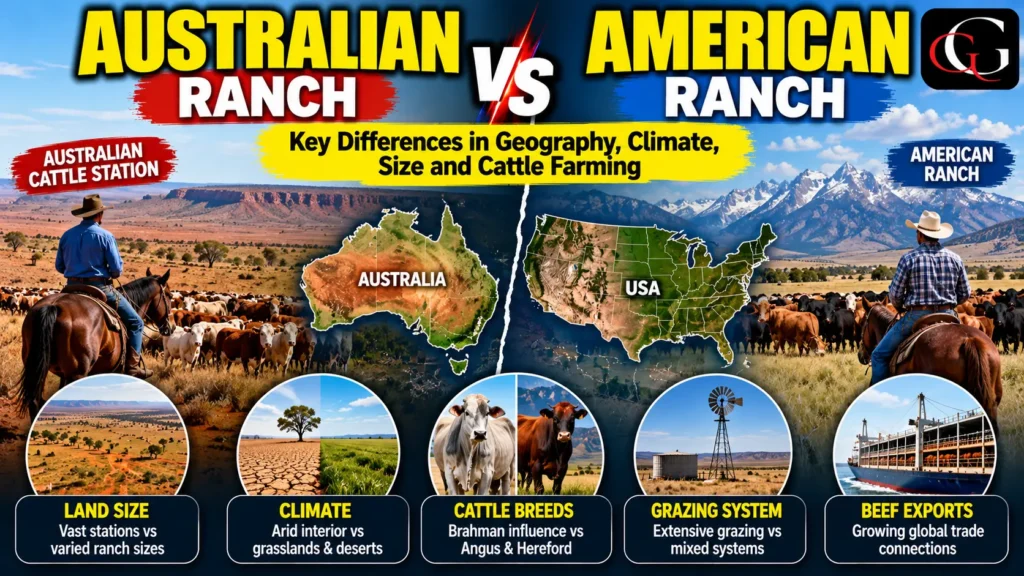
Australia’s cattle industry is attracting renewed international attention as its beef exports expand. In the first half of 2026, Australian beef exports to Canada rose sharply, while Australia also remains an important beef supplier to the United States. This provides a useful geographic question: How is an Australian cattle station different from an American ranch?
Although both are livestock-based land systems, their landscape, climate, property size, grazing methods and infrastructure can be very different.
About Australian Ranches and American Ranches
In Australia, the term “cattle station” is more commonly used for large-scale cattle properties, particularly in northern and inland Australia. In the United States, the equivalent term is generally “ranch.”
Australian Cattle Station
Australian cattle stations can be enormous because large areas of relatively dry land are required to support grazing animals. The Anna Creek Station in South Australia covers approximately 30,000 km², making it the world’s largest cattle station according to Guinness World Records
Australia’s pastoral areas extend across Queensland, the Northern Territory, Western Australia and parts of New South Wales. Much of this landscape has low or highly variable rainfall, meaning cattle may graze over extensive areas.
Australia had approximately 29.7 million cattle on holdings in June 2025, including 27.6 million beef cattle. Queensland alone accounted for about 13.5 million beef cattle.
American Ranch
American ranches are particularly associated with the Great Plains, Texas, New Mexico, Arizona, Montana, Wyoming and other western states. One famous example is King Ranch in Texas, covering roughly 825,000 acres (about 3,340 km²).
Unlike many Australian stations, American ranches can operate within landscapes ranging from grasslands and deserts to mountain valleys. Some ranches also use feedlots and more intensive cattle-finishing systems as part of the wider beef-production chain.
Geographic Significance
1. Climate Controls Ranch Size
The biggest geographic difference is often rainfall and carrying capacity. Australia’s dry interior requires extensive grazing areas, whereas some U.S. grassland regions can support more cattle per unit of land.
2. Different Names, Similar Function
“Station” and “ranch” describe broadly similar livestock enterprises, but station is strongly associated with Australia’s pastoral geography.
3. Land Use
Australia’s grazing and native-vegetation areas cover around 361 million hectares, concentrated particularly in northern and western Queensland, the Northern Territory and northern/northwestern Western Australia.
4. Global Beef Supply Chain
The two systems are also connected through international trade. Australian beef has established access to the U.S. market, with a combined 2026 duty-free entitlement of 449,909 tonnes under WTO and Australia–U.S. trade arrangements.
Frequently Asked Quetions
1. What is an Australian ranch called?
Large Australian livestock properties are generally called cattle stations, especially in the pastoral regions.
2. Which is larger, an Australian station or an American ranch?
Some Australian stations are substantially larger. Anna Creek, for example, covers about 30,000 km².
3. Why are Australian cattle stations so large?
Large areas are needed because much of Australia’s pastoral interior has low and variable rainfall and relatively low natural carrying capacity.