





Why did an old settlement develop at one particular place and not a few kilometres away? Geography often answers this question through two closely related ideas—site and situation. Together, they help explain why a settlement developed where it did and how its location influenced its later growth.
What is Site in Geography?
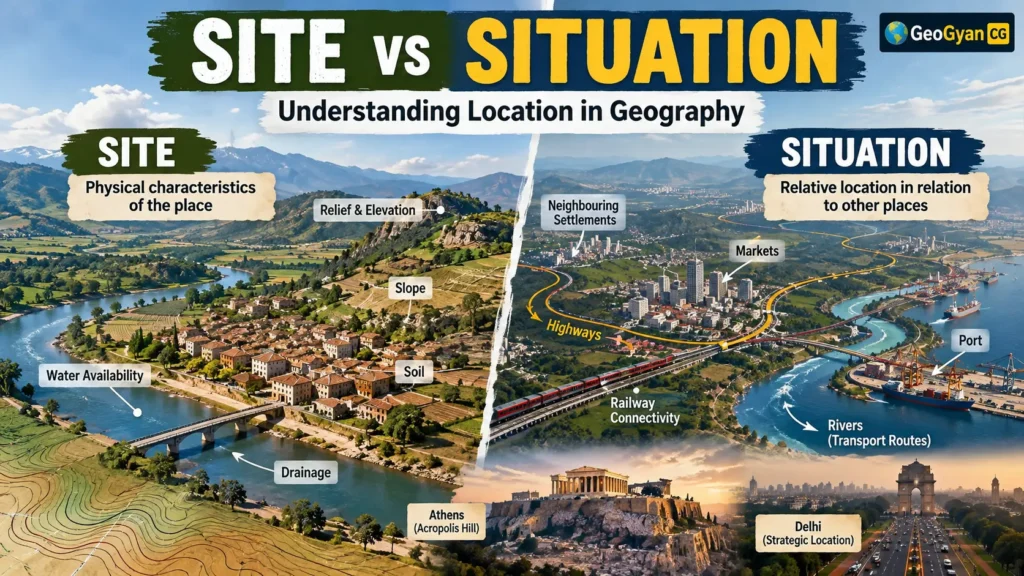
Site refers to the physical characteristics of the actual place where a settlement is located. It is the land on which a village, town or city stands.
Relief and elevation are important site factors. A settlement may develop on a relatively level surface because it is easier to construct buildings and roads there. Availability of water, drainage conditions, soil, slope, vegetation and natural resources can also influence the choice of site.
For example, many early settlements developed near rivers because water was essential for drinking, agriculture and other activities. However, people generally preferred relatively safe and elevated surfaces rather than locations that were frequently flooded.
The Acropolis of Athens provides a different example. It developed on a prominent rocky hill, where elevation offered defensive and visual advantages. The physical character of this location later became an important part of Athens’ cultural and urban landscape.
Thus, when we talk about site, the question is essentially: ‘What is the physical character of the place itself?’
What is Situation in Geography?
A settlement does not exist in isolation. Its development is also influenced by its position in relation to surrounding places. This relative location is called situation.
Situation may include proximity to major roads, rivers, ports, markets, neighbouring settlements, transport corridors and economic regions. These relationships can become particularly important as a settlement expands.
Delhi is a useful example. Its location near the Yamuna provided an important physical setting, but its wider geographical position between different parts of northern India and along important historical routes contributed greatly to its growth and political importance. This is the situational advantage of a settlement.
Similarly, Singapore has limited land area, but its position near one of the world’s major maritime routes between the Indian Ocean and the South China Sea has made its situation exceptionally important for international trade.
The distinction becomes especially useful in urban geography. A city may have a favourable site but a weak situation, or a difficult physical site but an exceptionally advantageous situation. Over time, transport technology, economic activity and regional connections can change the importance of situation, while the basic physical site remains relatively fixed.
FAQs
1. What is site in Geography?
Site is the physical character of the actual place where a settlement is located, including relief, elevation, slope, drainage, soil and water availability.
2. What is situation in Geography?
Situation is the relative location of a settlement in relation to other places, such as transport routes, markets, rivers, ports and neighbouring settlements.
3. What is the main difference between site and situation?
Site describes the place itself, while situation describes the place in relation to its surroundings.


