




Why is it in News?
The Northern Sea Route (NSR) along Russia’s Arctic coast is experiencing a sharp rise in shipping activity. 133 voyages were recorded on the route in September 2026, around four times the number recorded in September 2022 and 46% higher than in August 2026. The increase is being linked to declining Arctic Sea ice as well as disruptions and security concerns affecting traditional routes such as the Suez Canal and other Middle Eastern waterways.
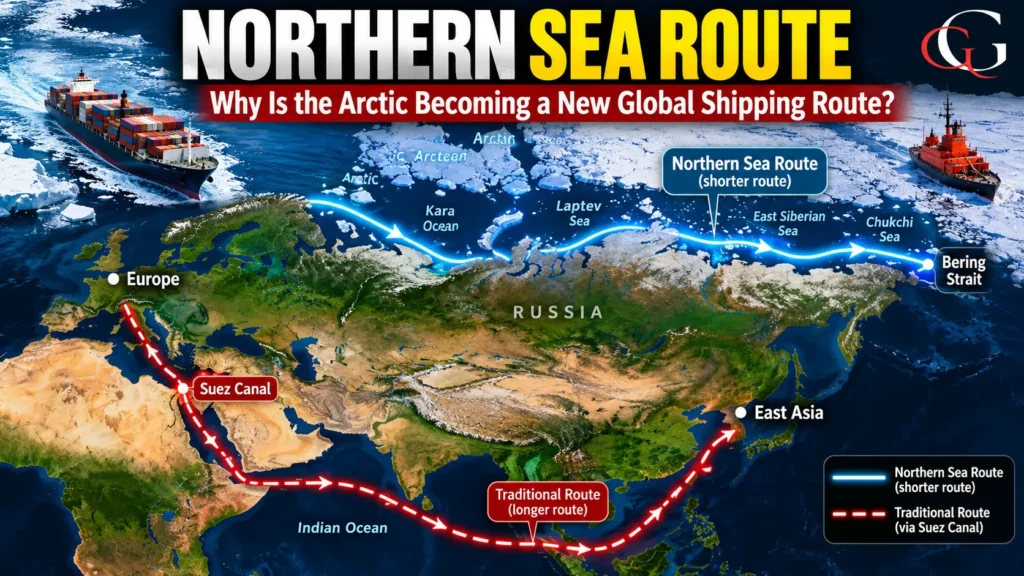
The growing activity is significant because the NSR provides a shorter maritime connection between Northern Europe and East Asia than the traditional Suez Canal route. A Chinese container ship recently reached the UK using the Arctic route considerably faster than it would have via Suez.
About the Northern Sea Route
- The Northern Sea Route is a maritime passage along the northern coast of Russia, extending from the Kara Sea in the west to the Bering Strait in the east. It passes through several Arctic seas, including the Kara, Laptev, East Siberian and Chukchi Seas.
- Its growing accessibility is closely connected with changes in Arctic Sea ice. NOAA reports that Arctic Sea ice has become younger and thinner, while the end-of-summer sea-ice extent in 2025 was 28% smaller than in 2005. NOAA also notes that declining sea ice is allowing greater maritime activity in the Arctic.
- However, the NSR is not a completely ice-free, year-round alternative to the Suez Canal. Ice conditions vary considerably by season and location, and ships may require ice-class construction or icebreaker assistance. Russia’s state-controlled Rosatom administers the route and issues permits.
Why is the route geographically important?
1. Shorter Europe–Asia connection:
The NSR can reduce the distance between parts of Europe and East Asia compared with routes through the Suez Canal.
2. Changing Arctic environment:
Declining sea ice is increasing the period during which some Arctic waters are navigable. NOAA identifies changing sea-ice conditions as an important factor behind increasing Arctic marine access.
3. Global trade and energy:
The route is increasingly being used for bulk commodities, crude oil and other energy shipments, strengthening its importance in global trade.
4. Geopolitical significance:
The NSR passes almost entirely along Russia’s Arctic coastline, making it important for Russia’s trade, energy exports and Arctic strategy. Chinese shipping activity is also increasing, giving the route wider international significance.
Challenges and environmental concerns
The Arctic remains a high-risk shipping environment. Severe weather, floating ice, limited ports, difficult navigation and inadequate emergency-response infrastructure can increase the risks of accidents and pollution. Greater shipping activity also raises concerns about impacts on fragile Arctic ecosystems and Indigenous communities.
Therefore, the Northern Sea Route should currently be viewed as an emerging Arctic shipping corridor, rather than a full replacement for established global routes.
Sources: FT
Frequently Asked Questions
1. Where is the Northern Sea Route located?
It runs along Russia’s northern Arctic coastline between the Kara Sea and the Bering Strait.
2. Why is the Northern Sea Route becoming more accessible?
Declining and thinning Arctic Sea ice is increasing seasonal navigability, although substantial ice hazards remain
3. Can the Northern Sea Route replace the Suez Canal?
Not at present. Its seasonal ice conditions, infrastructure limitations, environmental risks and operational requirements mean that it complements rather than simply replaces established routes.