



A maritime chokepoint is a narrow sea passage, strait or canal through which a large volume of ships, energy and goods must pass. Because alternative routes are often much longer or more expensive, disruption at one chokepoint can affect global trade, energy prices, shipping costs and supply chains.
Why is it in News?
Maritime chokepoints have become a major global trade issue in 2026, particularly because disruptions around the Strait of Hormuz and Bab el-Mandeb have changed shipping patterns.
The U.S. Energy Information Administration (EIA) reports that in Q2 2026, oil transit through the Strait of Hormuz averaged about 4.9 million barrels per day, compared with more than 20 million barrels per day in 2025. Meanwhile, the Strait of Malacca carried about 16.6 million barrels per day.
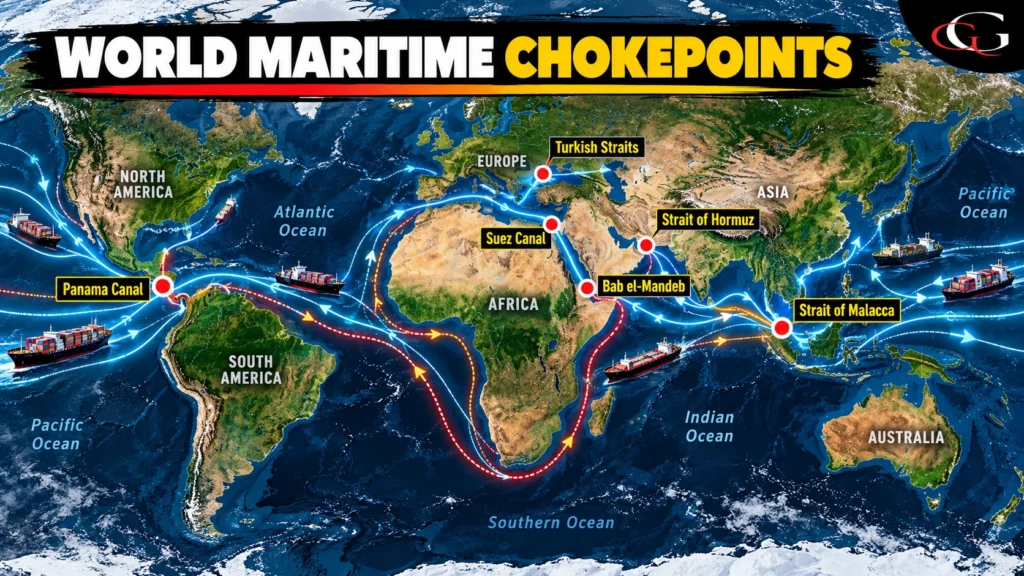
Recent disruptions in the Red Sea have also encouraged vessels to use the longer route around the Cape of Good Hope, adding time and cost to journeys between Asia, the Middle East and Europe. EIA estimates that routing around the Cape can add roughly 15 days to an oil-tanker journey between the Arabian Sea and Europe when the Suez route is unavailable.
About the World’s Major Chokepoints
1. Strait of Hormuz — Persian Gulf–Indian Ocean
Located between Iran and Oman, Hormuz connects the Persian Gulf with the Gulf of Oman and Arabian Sea. It is crucial for oil and LNG exports from Gulf producers. In the first half of 2025, about 20.9 million barrels/day of oil and petroleum liquids passed through it.
2. Strait of Malacca — Indian Ocean–Pacific Ocean
Between Malaysia, Indonesia and Singapore, Malacca provides the shortest major sea route between the Indian Ocean and East Asia. It carried about 23.2 million barrels/day of oil in the first half of 2025, making it a critical energy corridor for China, Japan, South Korea and other Asian economies.
3. Suez Canal — Mediterranean–Red Sea
The Suez Canal in Egypt connects the Mediterranean Sea with the Red Sea, creating a much shorter Europe–Asia shipping route than sailing around Africa. Along with the SUMED pipeline, it carried about 4.9 million barrels/day of oil in the first half of 2025.
4. Bab el-Mandeb — Red Sea–Gulf of Aden
This narrow passage lies between Yemen and the Horn of Africa and connects the Red Sea with the Gulf of Aden. It is geographically linked to the Suez route and is therefore important for Europe–Asia trade and energy shipments. Oil flows averaged about 4.2 million barrels/day in the first half of 2025.
5. Panama Canal — Atlantic–Pacific
The Panama Canal crosses the Isthmus of Panama and provides a shortcut between the Atlantic and Pacific oceans. It is particularly important for container shipping, agricultural commodities, energy products and trade between the eastern and western coasts of the Americas.
6. Turkish Straits — Black Sea–Mediterranean
The Bosporus and Dardanelles, together with the Sea of Marmara, form the Turkish Straits system. They provide the maritime connection between the Black Sea and Mediterranean, making them important for grain, oil and other commodities from Black Sea countries.
7. Danish Straits — Baltic Sea–North Sea
The Danish Straits provide the maritime gateway between the Baltic Sea and North Sea. They are particularly important for the movement of energy and commercial cargo from Baltic ports.
Why do chokepoints matter?
Their importance comes from a simple geographical principle:
Narrow passage → concentrated traffic → limited alternatives → greater disruption risk
When a chokepoint becomes unavailable, ships may have to take a much longer route. That can increase:
- Travel time
- Fuel consumption
- Freight rates
- Insurance costs
- Energy prices
- Delivery times
For example, disruption around Bab el-Mandeb has pushed some vessels toward the Cape of Good Hope, demonstrating how one geographical bottleneck can alter shipping patterns thousands of kilometres away.
Sources: USEIA
Frequently Asked Questions
1. What is a maritime chokepoint?
A maritime chokepoint is a narrow sea passage or canal through which a significant amount of international shipping must pass.
2. Which chokepoints are especially important for global oil trade?
The Strait of Hormuz and Strait of Malacca carry particularly large volumes of oil. EIA identifies them as the world’s key strategic oil chokepoints by transit volume.
3. What happens if a maritime chokepoint is blocked?
Ships generally have to use alternative routes, which can increase sailing distances, fuel consumption, freight costs and delivery times.