





Why is it in News?
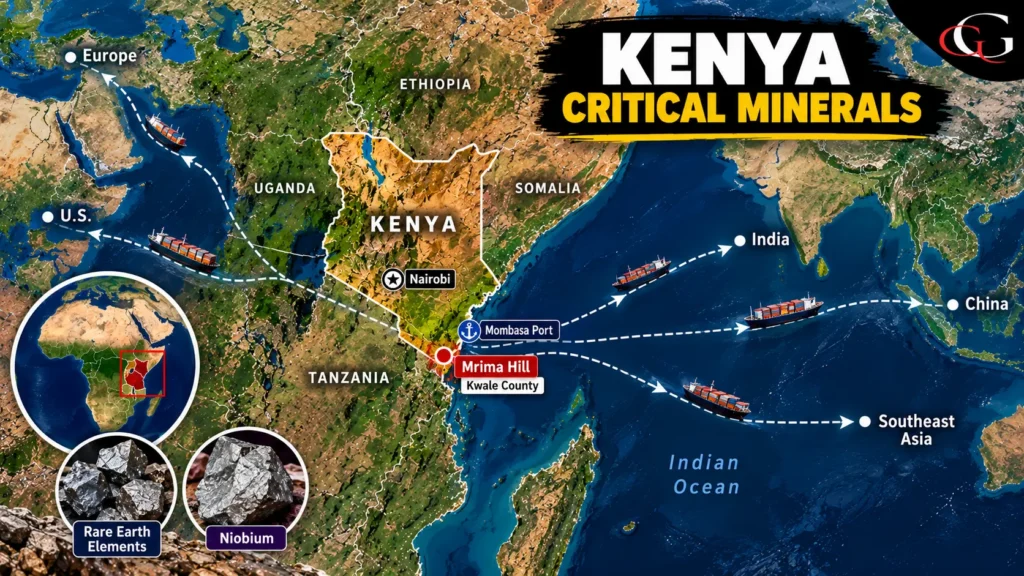
Kenya’s Mrima Hill mineral deposit in Kwale County has emerged as a new focus of global critical-mineral supply chains. On 28 September 2026, Kenya’s mining minister said talks with the United States on developing the country’s critical-mineral processing industry were at an advanced stage. The proposed cooperation includes refineries and processing plants in Kenya that could supply the U.S. market.
- Mrima Hill is attracting international interest because of its deposits of rare-earth elements and niobium.
- Six companies, including firms from the United States, Australia and China, are competing for the project, with the bidding process expected to conclude in late October.
- Kenya wants to move beyond exporting raw minerals and develop local processing and value addition.
- The development is significant because global industries are seeking to diversify critical-mineral supply chains that are currently highly concentrated in a few countries.
About Mrima Hill and Its Geographical Significance
Mrima Hill is located in Kwale County on Kenya’s Indian Ocean coast, about 65 km southwest of Mombasa. Its coastal location gives the project potential access to Kenya’s major maritime gateway and regional markets.
- Rare-earth elements: Important for permanent magnets, electric motors, electronics and several advanced technologies.
- Niobium: Used mainly to strengthen steel and produce high-strength alloys for infrastructure, transport and energy applications.
- Strategic location: Proximity to Mombasa Port could connect mineral production with international shipping and processing networks.
- Local processing: Kenya is seeking investment in refining and processing so that greater economic value remains within the country rather than exporting only raw materials.
- African mineral geography: Kenya could become another node in Africa’s expanding critical-mineral network alongside major mineral-producing countries such as the Democratic Republic of Congo and Zambia.
- Environmental geography: Mrima Hill is associated with a coastal forest ecosystem and has cultural importance for local communities, so mining development also raises questions about biodiversity and livelihoods.
Important data note: The frequently cited $62.4 billion figure is an estimate associated with the potential value of the deposit; Kenya’s government has cautioned that the resource figures do not constitute an economic viability assessment and further work is required.
Source: The EastAfrican, Reuters
Frequentlty Asked Questions
1. Where is Mrima Hill located?
Mrima Hill is in Kwale County, southeastern Kenya, on the Indian Ocean coast, southwest of Mombasa.
2. Which critical minerals are found at Mrima Hill?
The deposit is particularly associated with rare-earth elements and niobium, with other minerals also reported in preliminary assessments.
3. Why is Kenya important in the changing geography of critical minerals?
Kenya is attempting to combine its mineral resources with local processing, infrastructure and access to the Indian Ocean, potentially creating a new link between African resources and global manufacturing markets.