



The Caspian Sea is gaining renewed global importance because of changing trade routes, growing connectivity between Asia and Europe, and its strategic location between Russia, Iran, Central Asia and the South Caucasus. At the same time, rapidly declining water levels are emerging as a major geographical and environmental challenge.
Why is it in News?
- The Caspian Sea has gained attention as Iran looks towards its northern trade routes amid disruptions affecting its traditional maritime trade through the Persian Gulf and Strait of Hormuz.
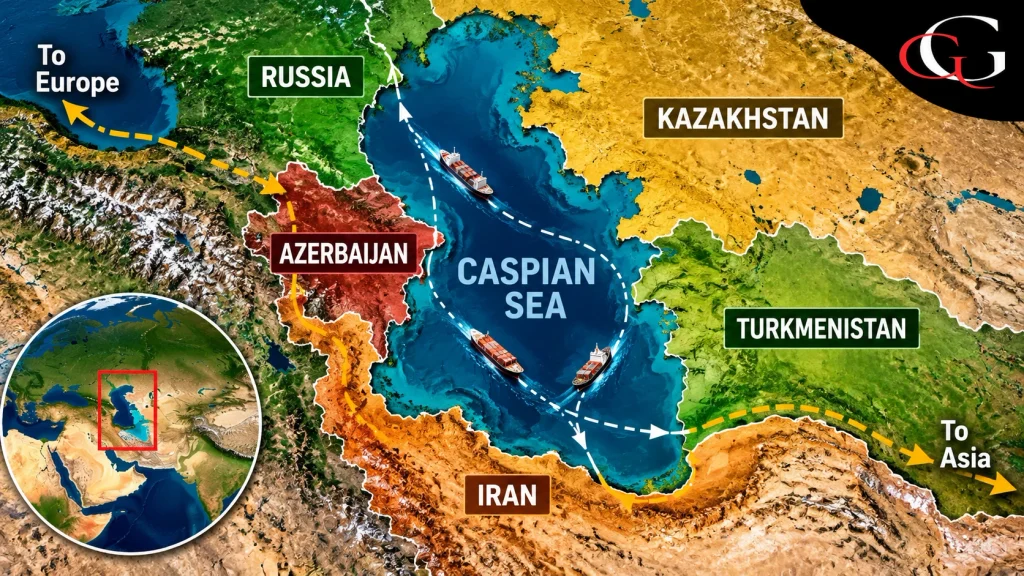
- Its importance is also increasing because of the Trans-Caspian International Transport Route, or Middle Corridor, which connects Asian and European markets through Central Asia, the Caspian Sea and the South Caucasus. The World Bank describes it as a strategic Asia–Europe trade route.
- The European Commission reported in 2026 that trade along the Trans-Caspian route has quadrupled since 2022, highlighting its growing role as an alternative Eurasian transport corridor.
- However, the Caspian Sea is facing a serious environmental challenge. According to the UN Environment Programme (UNEP), its water level has fallen by about 2 metres since the 1990s, with rising temperatures and increased evaporation contributing to the decline.
About the Caspian Sea
- Location: The Caspian Sea lies between Europe and Asia and is bordered by five countries — Russia, Kazakhstan, Turkmenistan, Iran and Azerbaijan. These five countries signed the Convention on the Legal Status of the Caspian Sea in 2018.
- Largest inland water body: It is the world’s largest landlocked body of water. Despite being called a “sea,” it has no natural connection with the world’s oceans.
- Major trade corridor: The Caspian forms an important maritime section of the Middle Corridor, linking Central Asia with the South Caucasus and Europe. It can help diversify trade routes between Asia and Europe.
- Energy importance: The Caspian region contains significant oil and natural gas resources, making it an important energy-producing region.
- Important ports: Major ports around the Caspian include Baku in Azerbaijan, Aktau in Kazakhstan, Turkmenbashi in Turkmenistan and Anzali in Iran. These ports support regional trade and transport networks.
- Environmental concern: Falling water levels could affect ports, shipping, fisheries, coastal settlements and energy infrastructure. Scientific research indicates that continued decline could substantially alter the Caspian coastline during this century.
Source: Aljazeera
Frequently Asked Questions
1. Which countries border the Caspian Sea?
The Caspian Sea is bordered by five countries: Russia, Kazakhstan, Turkmenistan, Iran and Azerbaijan.
2. Why is the Caspian Sea important for global trade?
The Caspian Sea is an important link in emerging Asia–Europe trade routes, particularly the Trans-Caspian International Transport Route (Middle Corridor), which connects Central Asia with the South Caucasus and Europe.
3. Why is the water level of the Caspian Sea declining?
The Caspian Sea’s water level has been declining because of factors including rising temperatures, increased evaporation, changes in river inflows and human activities. Continued decline could affect ports, shipping, fisheries and coastal ecosystems.