






Why is it in News?
Gandhi Jayanti will be observed on 2 October 2026, marking the 157th birth anniversary of Mahatma Gandhi, who was born on 2 October 1869 at Porbandar, Gujarat. Government of India’s MY Bharat platform is organizing activities in 2026 around themes such as cleanliness, tree plantation, digital literacy, community service and rural development.
The date also has a global significance. The United Nations observes 2 October as the International Day of Non-Violence, established by a UN General Assembly resolution in 2007. The UN’s 2026 message again highlights Gandhi’s legacy of peace, dialogue and non-violence.
About Gandhi Jayanti
- Gandhi Jayanti is celebrated every year on 2 October in India to commemorate the birth anniversary of Mohandas Karamchand Gandhi (Mahatma Gandhi).
- Gandhi was born in Porbandar, a coastal town in present-day Gujarat. His early life in Gujarat and later experiences in South Africa shaped his ideas about truth (Satya), non-violence (Ahimsa), Satyagraha and self-reliance.
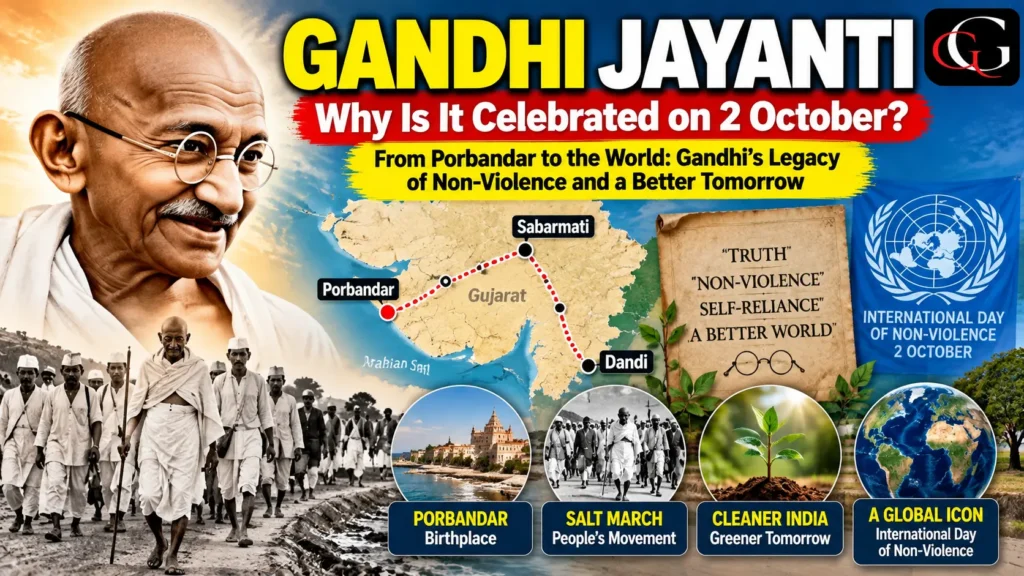
- After returning to India, Gandhi became an important leader of the Indian freedom movement. His approach relied heavily on mass mobilisation, civil disobedience and non-violent resistance. Major movements associated with him included the Non-Cooperation Movement, Civil Disobedience Movement and the 1930 Salt March from Sabarmati to Dandi.
- The geographical dimension of Gandhi’s movements is significant. His campaigns connected cities, villages, agricultural regions, coastal areas and major political centres, turning local issues into nationwide movements.
Geographic Significance
1. Porbandar: Birthplace of Gandhi
Porbandar is located on the Arabian Sea coast of Gujarat. Its location makes it an important geographic reference point in understanding Gandhi’s early life.
2. Dandi and the Salt March
The Sabarmati–Dandi route demonstrates how geography became part of political mobilisation. The 1930 Salt March transformed the coastal resource of salt into a symbol of resistance to colonial economic controls.
3. From India to the World
The UN’s designation of 2 October as the International Day of Non-Violence demonstrates how an idea originating in India’s freedom struggle acquired global relevance. The UN notes that Gandhi’s methods have influenced movements for civil rights and social change around the world.
4. Gandhi Jayanti and Sustainable Development
Contemporary observances also connect Gandhian ideas with cleanliness, community participation, sustainability and rural development. The 2026 MY Bharat programme specifically includes cleanliness drives, tree plantation, digital literacy and rural upliftment activities.
Frequently Asked Questions
1. When is Gandhi Jayanti celebrated?
Gandhi Jayanti is observed every year on 2 October, the birth anniversary of Mahatma Gandhi.
2. Why is 2 October important globally?
The United Nations observes 2 October as the International Day of Non-Violence, recognizing the universal relevance of non-violent action.
3. Where was Mahatma Gandhi born?
Mahatma Gandhi was born in Porbandar, Gujarat, on 2 October 1869.