




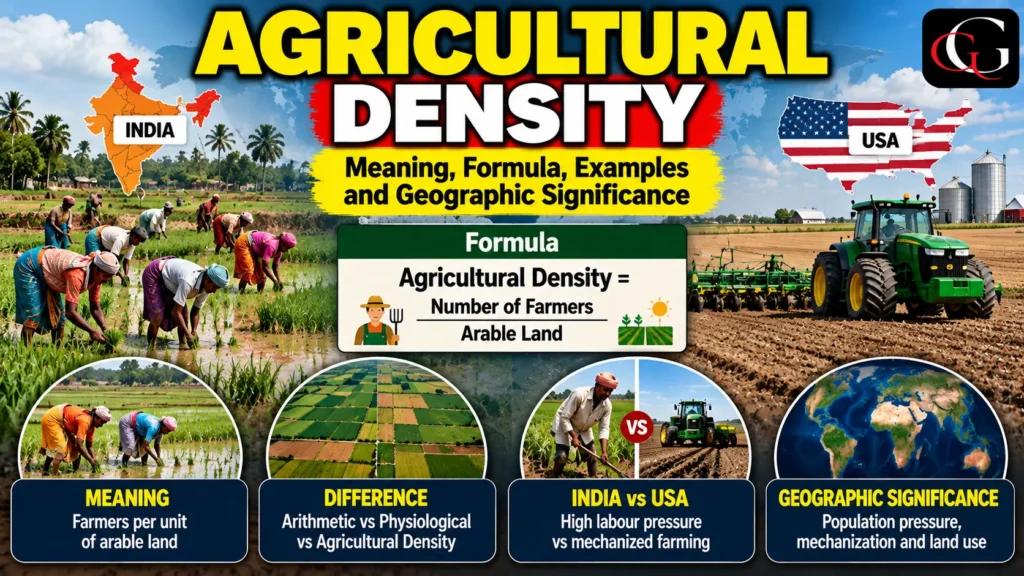
Why Is Agricultural Density Important?
Agricultural density is an important concept in population geography and agricultural geography. It helps explain the relationship between the number of people engaged in farming and the amount of land available for agriculture.
Unlike arithmetic density, which considers the total population of an area, agricultural density focuses specifically on farmers and arable land. It is particularly useful for comparing agricultural systems in countries with different levels of mechanization, land availability and population pressure.
What Is Agricultural Density?
Agricultural density is the number of farmers or agricultural workers per unit of arable land.
Formula:
Agricultural Density = Number of Farmers ÷ Arable Land
For example, if a region has 100,000 farmers and 500,000 hectares of arable land:
Agricultural Density = 100,000 ÷ 500,000 = 0.2 farmers per hectare
It is generally expressed as farmers per square kilometre of arable land or another appropriate unit of agricultural area. The concept is useful because arable land—not total land area—is the land actually suitable for growing crops.
How Is it Different from Other Types of Density?
1. Arithmetic Density
Arithmetic density measures the total population per unit of total land area.
Formula:
Total Population ÷ Total Land Area
It gives a general picture of population concentration.
2. Physiological Density
Physiological density measures the total population per unit of arable land.
Formula:
Total Population ÷ Arable Land.
A high physiological density indicates greater population pressure on agricultural land.
3. Agricultural Density
It measures farmers per unit of arable land. It therefore provides information about the human labour pressure and agricultural structure of a region.
Geographic Significance
1. Understanding Agricultural Development
It can provide clues about the level of agricultural development. A low agricultural density may occur in countries where agriculture is highly mechanized and relatively few people are required to cultivate large areas.
The United States, for example, has extensive mechanized agriculture, so a relatively small agricultural workforce can operate large farms.
2. Population Pressure on Land
A high agricultural density generally indicates that many farmers depend on a limited area of arable land. Such conditions are common in parts of South and Southeast Asia, where intensive cultivation supports large rural populations.
3. Mechanization
It is also related to technology and mechanization. Tractors, harvesters, irrigation systems and modern agricultural technology can reduce the number of workers required per unit of cultivated land.
4. Comparing Agricultural Systems
The indicator helps geographers compare subsistence, intensive and commercial agricultural systems and understand differences in land use, labour requirements and agricultural productivity.
Example: India vs USA
India has a much larger population dependent on agriculture and generally higher agricultural labour pressure on available farmland. The United States, in contrast, has extensive farms, high mechanization and a much smaller agricultural workforce relative to its agricultural land. Therefore, it should not be confused with agricultural productivity. A high agricultural density does not necessarily mean that agricultural production is high.
Sources:
Frequentlty Asked Questions
1. What is agricultural density?
It is the number of farmers or agricultural workers per unit of arable land.
2. What is the formula for agricultural density?
Agricultural Density = Number of Farmers ÷ Arable Land.
3. What does high agricultural density indicate?
It generally indicates that many agricultural workers depend on a relatively limited area of arable land, often reflecting intensive farming and greater labour dependence.