



Why is it in News?
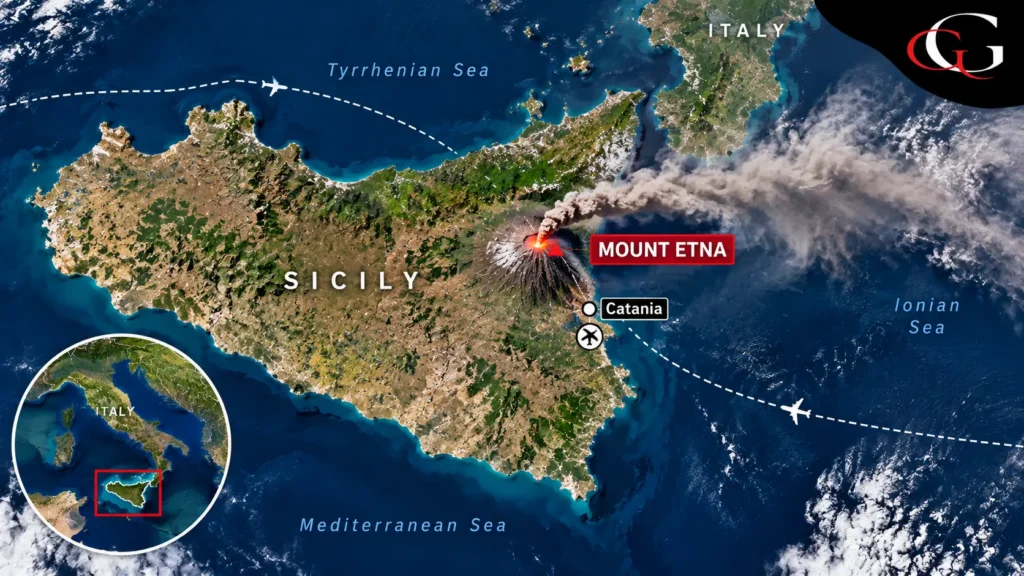
Mount Etna in Sicily has been producing volcanic ash emissions, disrupting air traffic at Catania Airport. On September 28, 2026, flight operations at Catania were suspended for a third consecutive day because of volcanic ash. Italy’s National Institute of Geophysics and Volcanology (INGV) issued a red aviation warning for Etna on September 24 because of ongoing ash emissions.
The repeated disruption highlights an important geographical relationship: Catania Airport is located relatively close to one of Europe’s most active volcanoes, making volcanic-ash monitoring important for aviation safety.
About Mount Etna
- Location: Mount Etna is located on the eastern coast of Sicily, Italy, overlooking the city of Catania. INGV places it at approximately 37.748°N, 14.999°E.
- Type: Etna is a stratovolcano with both effusive and Strombolian-style eruptive activity.
- Elevation: Its height changes as volcanic activity builds or modifies the summit cones; INGV currently gives a maximum height of about 3,324 m on its Etna information page.
- Tectonic setting: Etna lies in a complex tectonic environment associated with the collision between the African and Eurasian plates, while extensional tectonics in eastern Sicily facilitate magma ascent.
- Why is it so active? Its long eruptive history, complex fault systems and magma pathways contribute to its frequent volcanic activity.
- Why does ash affect flights? Volcanic ash can enter aircraft engines and damage aircraft systems, so aviation authorities closely monitor ash clouds and may restrict flights when the hazard is significant. INGV and Italy’s civil aviation authorities have specifically strengthened cooperation on volcanic-ash hazards.
Frequently Asked Questions
1. Where is Mount Etna located?
Mount Etna is on the eastern coast of Sicily, Italy, near the city of Catania.
2. Why does Mount Etna frequently erupt?
Etna’s location in a complex tectonic environment, combined with its active magma system and fault structures, allows magma to reach the surface relatively frequently.
3. Why does Mount Etna disrupt flights?
Volcanic ash can spread through the atmosphere and pose a serious hazard to aircraft. When ash affects the airspace around Catania, airport operations may be restricted or suspended.


