






Why is it in News?
The Mekong River basin is facing increasing pressure from the strengthening 2026 El Niño, as Southeast Asia experiences hotter and drier conditions. The Mekong is particularly important because millions of people depend on its water, agriculture and fisheries.
- The ASEAN Specialised Meteorological Centre reported strong El Niño conditions in August 2026, with El Niño expected to continue into early 2027 and potentially strengthen through October–November.
- ASEAN’s September–November outlook indicates a high probability of below-normal rainfall across much of the Maritime Continent, while above-normal temperatures are expected across much of the region.
- Recent reporting from the Mekong region indicates declining rainfall, lower water availability and pressure on fisheries, particularly affecting communities dependent on predictable river flows.
- Vietnam’s Mekong Delta is also preparing for increased risks from drought and saltwater intrusion during the coming dry season.
About the Mekong River and Its Geographical Significance
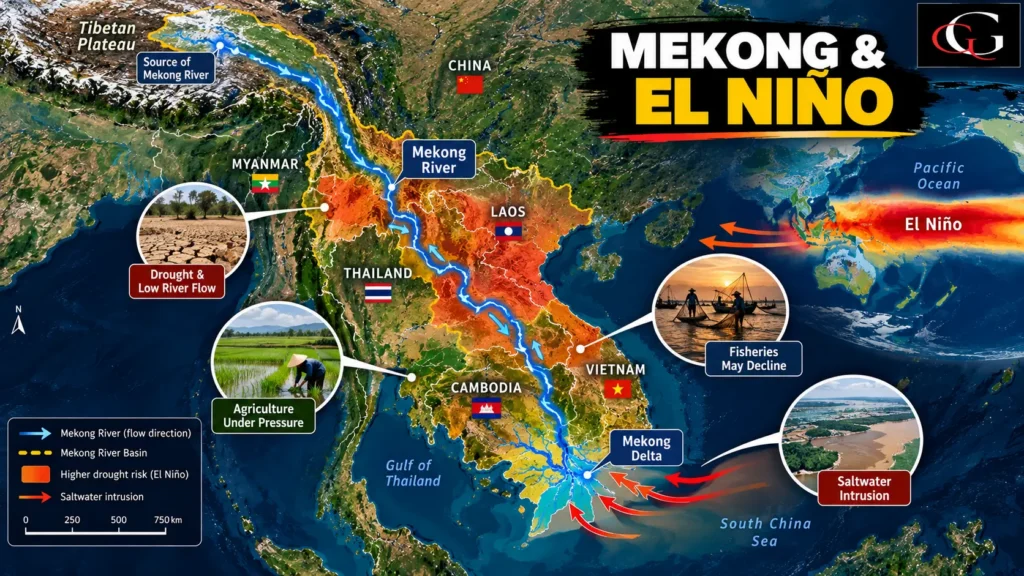
The Mekong is one of Asia’s major transboundary rivers. It rises on the Tibetan Plateau and flows through or along China, Myanmar, Laos, Thailand, Cambodia and Vietnam before reaching the South China Sea.
How can El Niño affect the Mekong?
1. Reduced rainfall and river flow
El Niño changes atmospheric circulation over the Pacific and can increase the probability of dry conditions in parts of Southeast Asia. Less rainfall can reduce tributary inflows and water availability.
2. Agriculture under pressure
The Lower Mekong Basin supports extensive rice cultivation. Lower river flows and water shortages can make irrigation more difficult and reduce agricultural productivity. The Mekong River Commission notes that drought can cause rice and other crop yields to decline.
3. Fisheries may decline
The Mekong supports one of the world’s most important inland fisheries. The MRC estimates the Lower Mekong Basin’s inland capture fisheries at around 2.3 million tonnes annually, providing food and income for millions.
4. Mekong Delta faces saltwater intrusion
When freshwater discharge into the delta falls, seawater can penetrate farther inland. This threatens rice fields, freshwater supplies and aquaculture in southern Vietnam.
5. Hydropower and navigation are affected
Lower river levels can influence hydropower generation and make transportation more difficult in some sections. The MRC identifies drought-related low flows as a risk to both transport and water-dependent activities.
An important geographical point
El Niño is only one pressure on the Mekong. River flows are also influenced by dams, water-resource development, climate change, land-use changes and other human activities. The Mekong River Commission specifically identifies changing rainfall, drought and shifting river flows as reasons for stronger regional cooperation and information sharing.
Sources: AP News, Vietnam.vn, MRC Mekong
Frequently Asked Questions
1. Where does the Mekong River flow?
The Mekong flows through or along China, Myanmar, Laos, Thailand, Cambodia and Vietnam.
2. Why is El Niño a concern for the Mekong?
El Niño can increase the likelihood of hotter and drier conditions, potentially reducing rainfall, river flows and water availability in parts of Southeast Asia.
3. Why is the Mekong Delta vulnerable?
The delta is a low-lying agricultural region. Reduced freshwater discharge can increase saltwater intrusion, threatening agriculture and freshwater resources.