





Why is it in News?
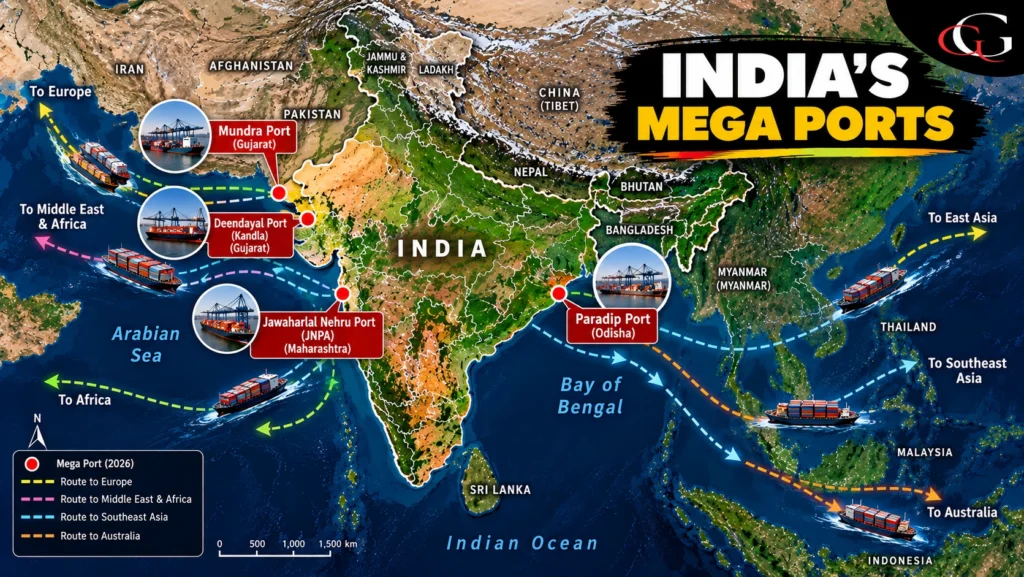
On 25 September 2026, the Ministry of Ports, Shipping and Waterways officially notified Deendayal (Kandla), Jawaharlal Nehru (Nhava Sheva), Paradip and Mundra as India’s first “Mega Ports” under Section 73 of the Indian Ports Act, 2025. The notification came into force upon publication in the Gazette of India.
The new classification is based on cargo throughput, rather than simply the physical size of a port. Under the criteria notified in July 2026, a port qualifies if it handled at least 150 million metric tonnes (MMT) of bulk cargo or 7.5 million TEUs of container cargo in the preceding financial year. The status remains valid for five years before review.
The four ports have a significant geographical distribution:
- Deendayal Port (Kandla) — Gujarat, Arabian Sea
- Mundra Port — Gujarat, Arabian Sea
- Jawaharlal Nehru Port (Nhava Sheva) — Maharashtra, Arabian Sea
- Paradip Port — Odisha, Bay of Bengal
Thus, three are on India’s western coast and one is on the eastern coast.
About India’s Mega Ports
The “mega port” label is a new statutory classification. It does not replace a port’s existing major/non-major status. For example, Deendayal, JNPA and Paradip remain major ports, while Mundra remains a non-major/private port despite receiving the new mega-port designation.
Why are these locations geographically important?
1. Deendayal Port, Gujarat
Located in the Gulf of Kachchh, it provides a maritime gateway for Gujarat and the industrial hinterland of northwestern and northern India.
2. Mundra Port, Gujarat
Located on the Gulf of Kachchh, Mundra is connected with extensive road, rail and logistics infrastructure and serves India’s western industrial and consumption markets.
3. Jawaharlal Nehru Port, Maharashtra
Located near Mumbai in Navi Mumbai, JNPA is a major container gateway for the Mumbai metropolitan region and its extensive hinterland.
4. Paradip Port, Odisha
Located on the Bay of Bengal, Paradip serves eastern and central India and handles major bulk commodities including coal, iron ore and other industrial cargo. Paradip handled about 150 MMT in FY 2025–26, according to the port authority.
Why does the classification matter geographically?
Ports are not isolated transport points. They connect coastal regions with inland industrial and agricultural hinterlands. The government has also been planning larger port clusters under Maritime Amrit Kaal Vision 2047, including Deendayal–Tuna Tekra and JNPA–Vadhavan, alongside other major port clusters.
Sources: GT, Paradip Port
Frequently Asaked Questions
1. What is a mega port in India?
Under the 2026 criteria, a port can qualify by handling 150 MMT of bulk cargo or 7.5 million TEUs of container cargo in the preceding financial year.
2. Which is the only eastern-coast port among India’s first four mega ports?
Paradip Port in Odisha is the only eastern-coast port among the four.
3. Is Mundra a major port?
No. Mundra is a non-major port, but it has been separately designated a mega port because the new classification is based on throughput and does not change the underlying major/non-major classification.


