



Why is it in News?
Hurricane Polo has brought renewed attention to tropical cyclones after making landfall in Baja California Sur, Mexico, on September 29, 2026. The storm reached Category 5 intensity earlier in its development before weakening to a Category 2 hurricane at landfall, with maximum sustained winds of about 110 mph (175 km/h).
Polo also demonstrates why a hurricane can remain a major hazard even after weakening. Heavy rainfall associated with the storm is threatening Baja California Sur and Sonora, while its tropical moisture is moving toward the U.S. Southwest, where forecasters have warned of flash flooding.
About Hurricanes: How Do They Form?
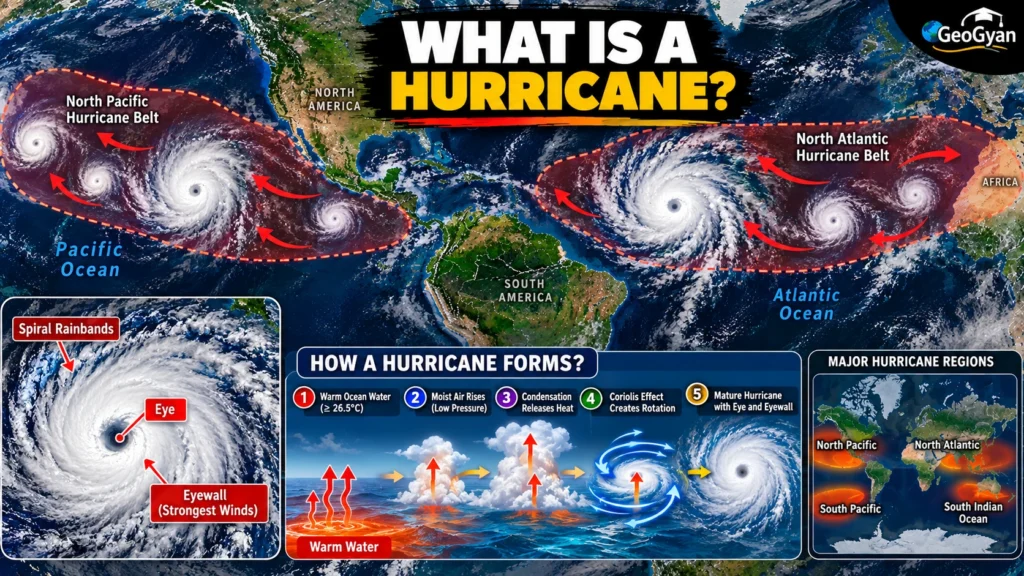
A hurricane is a powerful tropical cyclone that forms over warm tropical or subtropical oceans. The same type of storm is called a typhoon in the Northwest Pacific and a tropical cyclone in other regions.
1. Warm ocean water provides energy
Hurricanes generally require sea-surface temperatures of about 26.5°C or warmer over a sufficiently deep layer. Warm water increases evaporation, supplying moisture and latent heat to the developing storm.
2. Rising moist air creates low pressure
Warm, humid air rises near the ocean surface. As the air rises and cools, water vapor condenses into clouds and thunderstorms, releasing latent heat. This additional heat makes the air rise further and helps lower surface pressure.
3. Earth’s rotation creates the spiral
The Coriolis effect causes the developing circulation to rotate. Hurricanes therefore generally do not form directly at the Equator, where the Coriolis effect is too weak.
- Northern Hemisphere: counterclockwise rotation
- Southern Hemisphere: clockwise rotation
4. Low wind shear helps development
Strong changes in wind speed or direction with height can disrupt the vertical structure of a tropical cyclone. Therefore, relatively low vertical wind shear is usually favorable for hurricane development.
5. The eye and eyewall
A mature hurricane may develop:
- Eye — relatively calm central region
- Eyewall — ring of the strongest winds and thunderstorms
- Spiral rainbands — curved bands of heavy rain and thunderstorms
The eyewall generally contains the storm’s most intense winds.
6. Why hurricanes weaken over land
Once a hurricane moves over land, it loses its warm-ocean energy source. Friction and interaction with mountains or other terrain also disrupt the circulation. However, heavy rainfall and flooding can continue even after the storm loses hurricane strength, as demonstrated by Polo’s movement from Mexico toward the U.S. Southwest.
Frequently Asked Questions
1. What is the difference between a hurricane and a cyclone?
They are regional names for tropical cyclones. “Hurricane” is mainly used in the Atlantic and eastern/central Pacific.
2. Why don’t hurricanes form at the Equator?
The Coriolis effect is too weak near the Equator to provide the rotation needed to organize a tropical cyclone.
3. What is the strongest part of a hurricane?
The eyewall generally contains the strongest winds and most intense thunderstorms.


