




Estimated reading time: 4 minutes
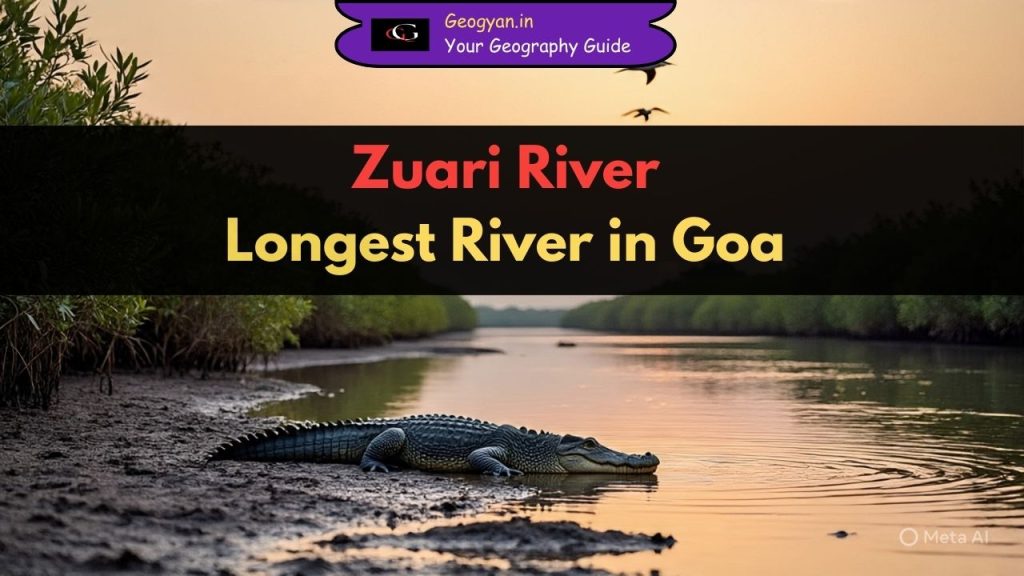
Table of contents
Why is Zuari River in the News?
The Zuari River has recently been in the news due to a cargo-loaded barge sinking near Goa Shipyard Limited and created significant navigation risks for vessels in the area. The incident involved a barge carrying 100 tonnes of iron ore pellets that struck a submerged wreck and quickly filled with water, but all eight crew members were successfully rescued.
As a result, the Mormugao Port Authority is planning an underwater survey and considering salvage operations, making river safety and vessel navigation urgent topics in recent news coverage of the Zuari River.
What Makes Zuari River Unique?
The Zuari River, with a total length of about 92 kilometers, holds the distinction of being the longest river in Goa. It originates in the Western Ghats of Karnataka and flows across Goa before draining into the Arabian Sea near Vasco da Gama.
The river supports ports, agriculture, fishing, and mining-based industries, making it an essential resource for Goa’s development. Along with the Mandovi River, Zuari forms the Mandovi-Zuari estuarine system, which ranks among the largest and most productive estuaries on India’s western coastline.
Where Does the Zuari River Originate?
The Zuari River rises in the Western Ghats, which act as a major water divide for peninsular rivers. It begins its journey in the lush forested ranges of Karnataka, gathers strength from rainfall-fed streams, and then enters Goa where it continues its long course toward the Arabian Sea. The river’s path covers mining-rich regions, which explains why Goa’s economy depends heavily on Zuari for ore transportation and navigation.
What is the Geographical Importance of Zuari River?
The Zuari River flows for 92 kilometers, and its drainage basin spreads across an area of nearly 2,500 square kilometers. It receives water from important tributaries such as Kushavati, Sanguem, and Uguem Rivers, which increase its volume and fertility.
The river creates a broad estuary near Vasco da Gama, which supports shipping and trade. Its navigable waters allow the transportation of goods, especially iron ore exports, making it a backbone for Goa’s international trade.
Why is Zuari Called the Lifeline of Goa?
The people of Goa refer to Zuari as their lifeline because it supports multiple sectors. The river provides water for irrigation in agricultural fields, supports fishing communities living along its banks, and enables the export of minerals through port facilities at Vasco da Gama.
Shipbuilding industries and small-scale trade also depend on its estuarine network. Without Zuari, Goa’s economic structure would collapse, and its cultural identity would weaken.
What is the Ecological Importance of Zuari River?
The Zuari River supports dense mangrove forests, which protect Goa’s coast from erosion and storms. These mangroves create breeding grounds for fish and act as nesting sites for migratory birds. The estuary also provides habitat for crocodiles and unique estuarine fish species, turning Zuari into a hotspot of biodiversity. The estuary moderates floods during the monsoon and ensures that groundwater remains replenished throughout the year.
Quick Exam Facts on Zuari River
- Length: 92 km, the longest river of Goa.
- Drainage Basin: Around 2,500 sq. km.
- Major Tributaries: Kushavati, Sanguem, Uguem.
- Estuary: Forms the Mandovi-Zuari estuarine system, one of India’s largest.
- Economic Role: Navigation, fishing, irrigation, iron ore exports, shipbuilding.
- Ecology: Mangroves, crocodiles, migratory birds, estuarine biodiversity.
FAQs on Zuari River
Q1. Where does the Zuari River meet the sea?
The Zuari River meets the Arabian Sea near Vasco da Gama.
Q2. Which is longer – Zuari or Mandovi?
The Zuari River (92 km) is longer than the Mandovi, making it the longest river in Goa.
Q3. What are the main industries dependent on Zuari?
Mining, shipbuilding, agriculture, and fishing depend directly on the Zuari River.
Q4. What environmental threats endanger Zuari River?
Pollution from industries, mining residues, salinity intrusion, and overfishing threaten the river.
Q5. Why is the Zuari-Mandovi estuary famous?
It is famous as one of the largest estuarine systems of India, rich in biodiversity and trade activity.


