






Access the latest NCERT Solutions for Class 6 Geography Chapter-2: Oceans and Continents, updated for 2024-2025. Solution is designed to help students tackle difficult questions with ease. The content is written in simple, easy-to-understand language.
Exercise
Here’s a guide to help answer the questions and complete the activities from Chapter 2: Oceans and Continents in the NCERT Class 6 Geography book.
1. Explain the following terms:
(a) Continent
A continent is a large continuous mass of land on Earth. There are generally seven continents: Asia, Africa, North America, South America, Antarctica, Europe, and Australia. Each continent varies in size, population, and geography.
(b) Ocean
An ocean is a vast body of saltwater that covers a significant part of Earth’s surface. There are five major oceans: Pacific, Atlantic, Indian, Southern (Antarctic), and Arctic Oceans. Oceans regulate climate, support marine life, and are crucial for the water cycle.
(c) Island
An island is a piece of land completely surrounded by water but smaller than a continent. Islands can be found in oceans, seas, rivers, and lakes. Examples include Greenland, the world’s largest island, and Andaman and Nicobar Islands in India.
2. Let Us Draw
Activity: Without looking at the maps in the chapter, try drawing the continents on a blank sheet of paper. Use colors to differentiate each continent. After completing your drawing, compare it to the map provided in the chapter, noting any differences in shape and size.
Goal: This exercise will help you understand the relative size and position of each continent on Earth. It’s a fun way to practice memory recall and improve geographical knowledge.
3. Let Us Do
Task: On a world outline map, label all the continents and oceans.
- Continents: Asia, Africa, North America, South America, Antarctica, Europe, Australia
- Oceans: Pacific Ocean, Atlantic Ocean, Indian Ocean, Southern Ocean, Arctic Ocean
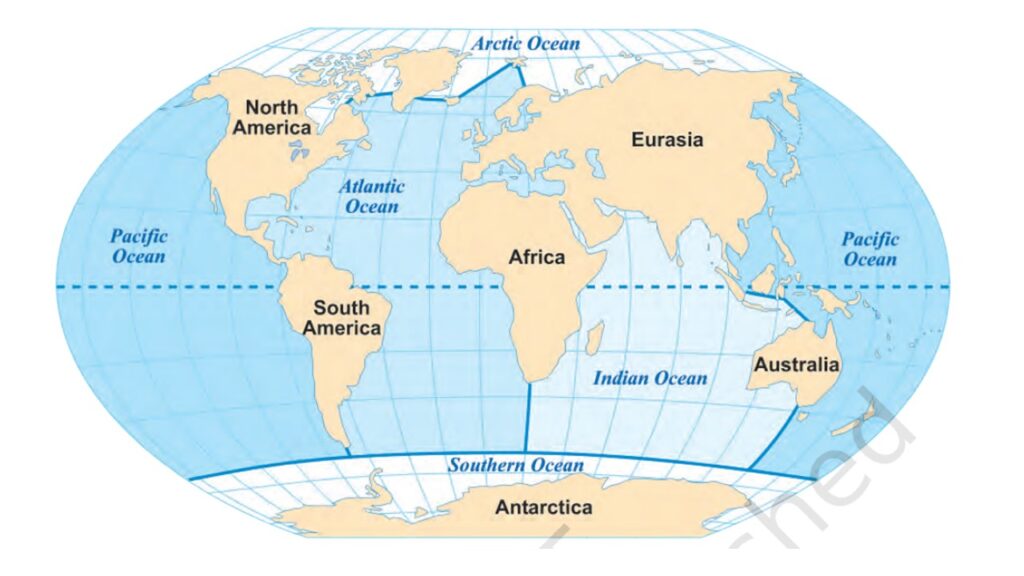
This activity will reinforce the locations of continents and oceans, essential for understanding Earth’s geography.
Other Important Short answer Questions
Based on Chapter 2: Oceans and Continents from the NCERT Class 6 Geography textbook, here are 20 important short answer questions and answers to help students understand the concepts, structured to be exam-relevant and useful for NCERT-based and UPSC exams.
1. What are the main differences between an ocean and a continent?
Oceans are vast bodies of saltwater covering approximately 71% of Earth’s surface, while continents are large landmasses that cover the remaining 29%. Oceans contain marine life, and continents are habitats for various plant, animal, and human populations.
2. Why is Earth often called the “Blue Planet”?
Earth is known as the “Blue Planet” because nearly three-fourths of its surface is covered by water, mainly in the form of oceans, which reflect blue color when seen from space, giving Earth its blue appearance.
3. Name the five oceans of the world.
The five oceans are:
- Pacific Ocean
- Atlantic Ocean
- Indian Ocean
- Southern (Antarctic) Ocean
- Arctic Ocean
4. How are oceans important for Earth’s climate?
Oceans regulate Earth’s climate by absorbing solar heat, circulating warm and cold currents, and generating rainfall through evaporation. They play a major role in balancing temperatures globally and support life by maintaining water and carbon cycles.
5. Describe the Pacific Ocean and its significance.
The Pacific Ocean is the largest and deepest ocean on Earth. It stretches between Asia, Australia, the Americas, and Antarctica, and is known for its rich biodiversity, seismic activity, and significant role in regulating global weather patterns.
6. Explain what the term “marine” refers to.
The term “marine” relates to anything associated with oceans and seas, including marine plants (algae, seaweed) and animals (fish, whales). It covers aspects of the oceanic ecosystem and is critical in the study of oceanography.
7. What role do continents play in the water cycle?
Continents play a key role in the water cycle by supporting rivers, lakes, and groundwater systems. Rainfall on continents flows into rivers and streams, eventually reaching oceans, which helps maintain the cycle of evaporation, condensation, and precipitation.
8. Why is the Indian Ocean significant for India?
The Indian Ocean, bordering India to the south, is crucial for India’s climate, particularly the monsoon rains that are essential for agriculture. It also supports trade routes, marine resources, and connects India to Africa and Southeast Asia.
9. How do oceans support marine life?
Oceans provide habitat, food, and breeding grounds for a vast variety of marine species, from microscopic algae to large mammals like whales. Marine flora produces over half of the world’s oxygen, making oceans essential for life on Earth.
10. What is the importance of the Arctic Ocean?
The Arctic Ocean, the smallest and shallowest ocean, plays a vital role in regulating global climate by reflecting solar radiation through its ice cover. It is home to unique marine life and is a critical indicator of climate change due to melting ice.
11. Define a continent and list the seven continents.
A continent is a large continuous landmass. The seven continents are:
- Asia
- Africa
- North America
- South America
- Antarctica
- Europe
- Australia
12. How are Europe and Asia sometimes considered a single continent?
Europe and Asia share a continuous landmass and are often referred to as a single continent, “Eurasia,” due to geographic continuity. However, cultural and historical differences typically separate them into two distinct continents.
13. What is a tsunami, and how does it originate?
A tsunami is a series of large ocean waves typically caused by underwater earthquakes, volcanic eruptions, or landslides. It can travel thousands of kilometers and causes widespread damage to coastal areas upon reaching land.
14. Why are oceans called the “lungs of the planet”?
Oceans produce over 50% of the world’s oxygen, mainly through marine plants like algae and phytoplankton, similar to how lungs provide oxygen to the body. Oceans also absorb carbon dioxide, helping to balance the global ecosystem.
15. Explain why the Southern Hemisphere has more water than land.
The Southern Hemisphere contains major portions of the Pacific, Atlantic, and Indian Oceans, leading to a higher concentration of water. This influences the global climate, with more stable temperatures and less extreme seasonal variations.
16. What is the significance of the United Nations’ World Oceans Day?
Observed on June 8, World Oceans Day raises awareness about ocean conservation, pollution, and sustainable use of marine resources. It highlights the critical role oceans play in supporting life and the need to protect them.
17. How did the Indian Ocean tsunami of 2004 impact India?
The 2004 Indian Ocean tsunami, caused by an earthquake near Indonesia, severely affected India’s Andaman and Nicobar Islands and coastal areas in Tamil Nadu and Kerala, causing significant loss of life and damage to infrastructure.
18. Describe the role of the National Disaster Management Authority (NDMA) in India.
India’s NDMA develops policies and coordinates efforts to manage natural disasters, including tsunamis. It works on early warning systems, disaster preparedness, and recovery plans to minimize damage and protect lives.
19. What are some ways human activities pollute oceans?
Oceans face pollution from plastic waste, oil spills, chemicals, and excessive fishing. These pollutants harm marine life, disrupt ecosystems, and threaten biodiversity. Sustainable practices and waste reduction are essential for ocean health.
20. What are islands, and how are they different from continents?
Islands are land masses surrounded by water but are much smaller than continents. While continents are vast and support diverse ecosystems and human populations, islands are limited in size and often have unique flora and fauna.
MCQs on Chapter 2: Oceans and Continents
Here are 20 multiple-choice questions (MCQs) with answers based on Chapter 2: Oceans and Continents from the NCERT Class 6 Geography textbook. These questions are suitable for NCERT and UPSC exam preparation.
MCQs on Oceans and Continents
- What proportion of Earth’s surface is covered by water?
a) Half
b) One-fourth
c) Three-fourths
d) Two-thirds - Which color is most visible from space, giving Earth its nickname as the “Blue Planet”?
a) Green
b) Blue
c) White
d) Brown - What is the largest water body on Earth called?
a) Bay
b) Sea
c) River
d) Ocean - Which is the largest ocean on Earth?
a) Atlantic Ocean
b) Indian Ocean
c) Pacific Ocean
d) Arctic Ocean - What is the term for a large, continuous expanse of land on Earth?
a) Plateau
b) Island
c) Continent
d) Mountain - How many continents are there according to the commonly accepted count?
a) 5
b) 6
c) 7
d) 8 - Which ocean is located entirely in the Northern Hemisphere?
a) Indian Ocean
b) Arctic Ocean
c) Pacific Ocean
d) Southern Ocean - Which continent is the smallest in size?
a) Africa
b) Australia
c) Europe
d) South America - The Indian Ocean is bordered by which two seas near India?
a) Black Sea and Red Sea
b) Arabian Sea and Bay of Bengal
c) Caspian Sea and North Sea
d) Adriatic Sea and Baltic Sea - What natural disaster, originating from the ocean, is caused by undersea earthquakes or volcanic eruptions?
a) Cyclone
b) Tsunami
c) Tornado
d) Avalanche
MCQs on Oceans’ and Continents’ Impact on Life
- What nickname is given to oceans because of their role in oxygen production?
a) Earth’s food source
b) Planet’s lungs
c) Earth’s backbone
d) World’s kitchen - Which continent is considered the coldest?
a) North America
b) Asia
c) Antarctica
d) Europe - The Indian Navy’s emblem has the phrase “Sam noh Varunah” meaning:
a) Glory to the Sun
b) Strength and Courage
c) Be auspicious to us, O Varuna
d) Defend the Land - Which ocean is located mainly in the Southern Hemisphere?
a) Atlantic Ocean
b) Pacific Ocean
c) Arctic Ocean
d) Southern Ocean - Which two continents are often considered as one due to their shared landmass?
a) North and South America
b) Africa and Asia
c) Asia and Europe
d) Europe and Africa - Which continent has the largest land area?
a) North America
b) Asia
c) Africa
d) Antarctica - What is the purpose of World Oceans Day celebrated on June 8?
a) To encourage global maritime trade
b) To raise awareness of ocean health
c) To celebrate the discovery of new marine species
d) To honor marine sports - Greenland is known as the world’s largest:
a) Continent
b) Island
c) Ocean
d) Bay - What phenomenon causes heavy rainfall essential for agriculture in India, originating from the ocean?
a) Tsunami
b) Monsoon
c) Cyclone
d) Drought - Which continent is bordered by both the Pacific and Atlantic Oceans?
a) Asia
b) Africa
c) Australia
d) North America
Answers
- c) Three-fourths
- b) Blue
- d) Ocean
- c) Pacific Ocean
- c) Continent
- c) 7
- b) Arctic Ocean
- b) Australia
- b) Arabian Sea and Bay of Bengal
- b) Tsunami
- b) Planet’s lungs
- c) Antarctica
- c) Be auspicious to us, O Varuna
- d) Southern Ocean
- c) Asia and Europe
- b) Asia
- b) To raise awareness of ocean health
- b) Island
- b) Monsoon
- d) North America


