





Estimated reading time: 3 minutes
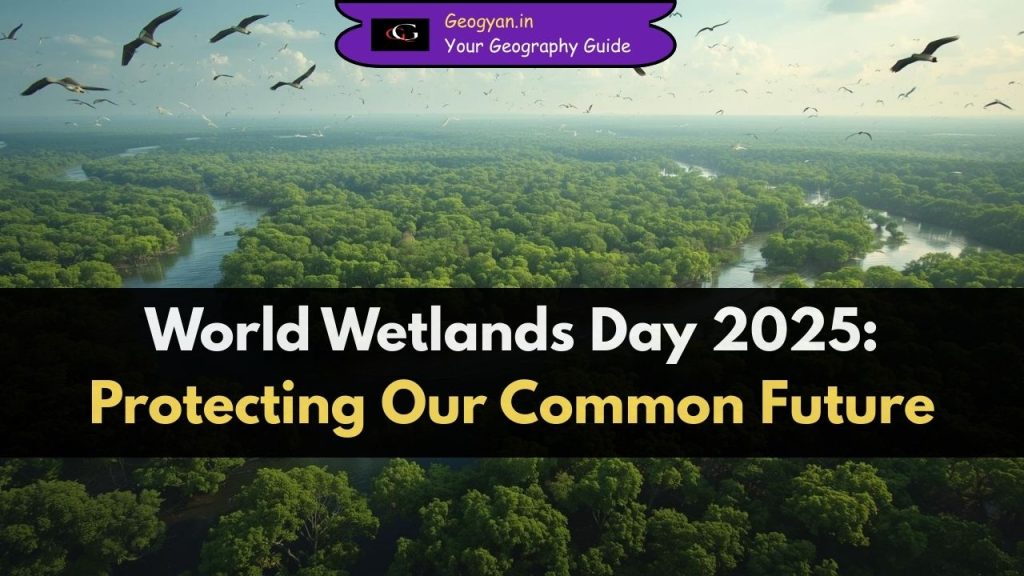
Table of contents
Recent News on World Wetlands Day 2025
The Union Ministry of Environment, Forest and Climate Change (MoEFCC) organized celebrations for World Wetlands Day 2025 at the Parvati Arga Ramsar Site in Uttar Pradesh on February 2, 2025. This year marks significant progress in India’s conservation efforts with the addition of new Ramsar sites such as Udhwa Lake in Jharkhand, Theerthangal and Sakkarakottai in Tamil Nadu, and Khecheopalri in Sikkim, increasing India’s total to 89 Ramsar wetlands — the highest in South Asia.
The government also announced a new nature-culture tourism corridor between Ayodhya and Devi Patan in Uttar Pradesh. These initiatives emphasize the urgent global and national need to protect wetlands from threats like industrial pollution and encroachment, as wetlands are essential to ecological balance and human well-being.
What Are Wetlands?
Wetlands are unique ecosystems flooded with water either permanently or seasonally. They include marshes, swamps, peatlands, and floodplains. Wetlands act as natural water filters, replenish groundwater, and provide habitats for diverse flora and fauna. Their geographical distribution depends on climate, rainfall, and landforms.
Why Is World Wetlands Day Celebrated?
World Wetlands Day is observed to raise public awareness about the importance of wetlands, mark the adoption of the Ramsar Convention on Wetlands (1971), and encourage conservation and sustainable use. The 2025 theme, Protecting Wetlands for Our Common Future, stresses the need for bold actions to restore and safeguard wetlands for current and future generations.
Geographical Importance of Wetlands?
- Wetlands ensure water security by regulating groundwater and controlling floods.
- They serve as biodiversity hotspots supporting over 40% of the world’s plant and animal species.
- Wetlands act as carbon sinks, reducing greenhouse gases and mitigating climate change.
- Geographically, wetlands influence landform development and microclimate regulation.
- Rapid urbanization and industrial activities threaten wetlands globally, reducing these vital ecosystem services.
What Are Recent Government Initiatives?
- The Amrit Dharohar Initiative, launched in 2023, focuses on conserving Ramsar sites through species protection, habitat restoration, nature tourism, livelihoods, and carbon management.
- India is developing a nature-culture tourism corridor between Ayodhya and Devi Patan to promote sustainable tourism.
- Efforts to map and protect wetlands continue through projects like the Wetland Atlas 2024 and stricter pollution control measures.
FAQs
Q1. What are the main types of wetlands from a geographical perspective?
Wetlands are classified into inland (rivers, lakes, marshes), coastal (estuaries, mangroves), and human-made (reservoirs, fish ponds).
Q2. What is the Ramsar Convention?
It is an international treaty adopted in 1971 for the conservation and wise use of wetlands worldwide.
Q3. How many Ramsar sites does India have currently?
India has 89 Ramsar wetlands, the highest number in South Asia.
Q4. Why do wetlands help control climate change?
Wetlands store large amounts of carbon in their plants and soils, acting as significant carbon sinks.
Q5. What is the theme for World Wetlands Day 2025?
The theme is Protecting Wetlands for Our Common Future, focusing on urgent conservation action worldwide.


