





Estimated reading time: 4 minutes
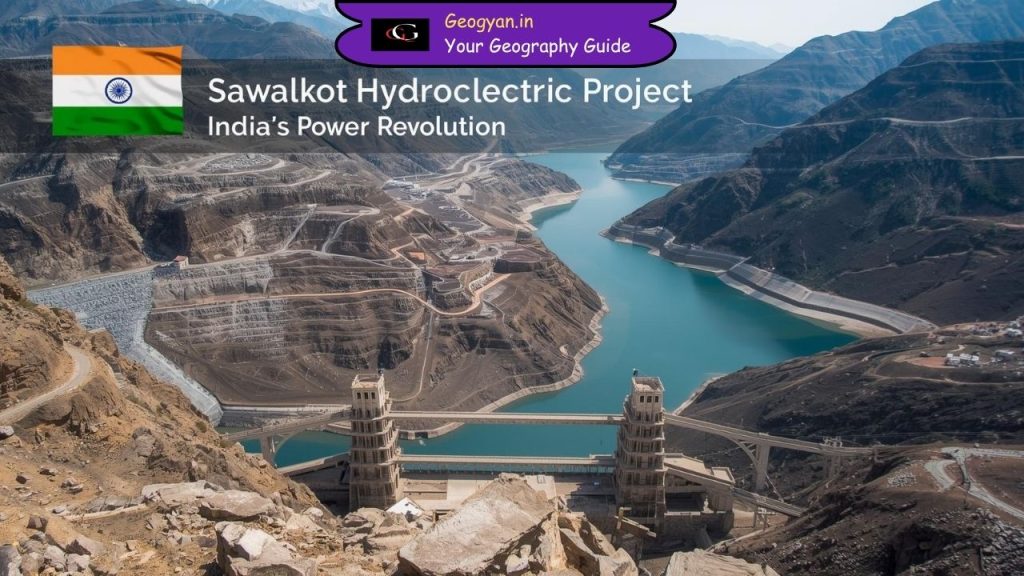
Table of contents
- Recent News Update
- Sawalkot Hydroelectric Project?
- How Will the Project Be Constructed?
- Environmental and Geographical Aspects
- Why Is the Sawalkot Project Important for India?
- How Does the Project Contribute to Hydropower Growth?
- Quick Facts Table: Sawalkot Hydroelectric Project
- Frequently Asked Questions (FAQs)
- Also Read
Recent News Update
The Sawalkot Hydroelectric Project, being developed by NHPC Limited, has received environmental clearance for construction in two phases with an estimated cost of ₹31,380 crore. The project is located on the Chenab River across the Ramban, Reasi, and Udhampur districts of Jammu and Kashmir (UT).
This ambitious hydropower project will play a strategic role in India’s energy security, water management, and Indus Waters Treaty optimization.
Sawalkot Hydroelectric Project?
The Sawalkot Hydroelectric Project is a run-of-the-river scheme, designed to utilize the flowing water of the Chenab River for power generation without major water diversion.
- Total Installed Capacity: 1,856 MW
- Phase 1: 6×225 MW + 1×56 MW
- Phase 2: 2×225 MW
- Total Area: 1,401 hectares
- Estimated Cost: ₹31,380 crore
- Dam Height: 192.5 meters (Concrete Dam)
- Developed By: National Hydroelectric Power Corporation (NHPC)
The project includes an underground power station, short upstream water channel, and a system to carry water back to the river, ensuring environmental sustainability.
How Will the Project Be Constructed?
The project will be developed in two stages:
- Stage 1 (6×225 MW + 1×56 MW) – Main construction and infrastructure phase.
- Stage 2 (2×225 MW) – Expansion for full capacity utilization.
It also involves:
- A massive 192.5 m high concrete dam
- Upstream short water channel
- Underground powerhouse
- Environmental flow (E-flow) release system
- Online monitoring system for ecological safety
Environmental and Geographical Aspects
The Expert Appraisal Committee (EAC) of the Ministry of Environment, Forest and Climate Change (MoEFCC) has granted the green signal after strict evaluation.
Key Environmental Safeguards:
- Dedicated team for environmental management
- Continuous online monitoring of e-flow and biodiversity
- Forest clearance under the Forest (Conservation) Act, 1986
- Wildlife clearance, if applicable
- Compensation for land acquisition and socio-economic impacts
This ensures that Chenab Valley’s ecology remains protected while enhancing hydro-energy potential.
Why Is the Sawalkot Project Important for India?
India currently lacks the capacity to store the 3.6 million acre-feet (MAF) of water from western rivers allocated under the Indus Waters Treaty.
The Sawalkot project will:
- Help India store additional water on western rivers.
- Support energy generation in Jammu & Kashmir.
- Reduce flood risks and enhance irrigation potential.
- Boost India’s hydro capacity — only 3,482 MW has been utilized out of the 20,000 MW potential from western rivers.
How Does the Project Contribute to Hydropower Growth?
India’s hydroelectric capacity is a vital part of renewable energy development.
The Sawalkot project will enhance basin-wide energy efficiency, regional employment, and local economy while maintaining eco-sustainability.
It will also promote green energy transition by reducing dependence on thermal power.
Quick Facts Table: Sawalkot Hydroelectric Project
| Feature | Details |
| Project Name | Sawalkot Hydroelectric Project |
| Location | Ramban, Reasi & Udhampur, J&K (UT) |
| River | Chenab River |
| Total Capacity | 1,856 MW |
| Cost | ₹31,380 Crore |
| Developer | NHPC Limited |
| Dam Height | 192.5 m |
| Total Area | 1,401 hectares |
| Project Type | Run-of-the-River Scheme |
| Phases | Two (Stage 1 & Stage 2) |
| Environmental Clearance | MoEFCC (Sept 2025) |
| Forest & Wildlife Clearance | Required under FCA 1986 |
Sources: TOI
Frequently Asked Questions (FAQs)
Q1. Where is the Sawalkot Hydroelectric Project located?
It is located on the Chenab River across Ramban, Reasi, and Udhampur districts in Jammu & Kashmir (Union Territory).
Q2. What is the total installed capacity of the project?
The total capacity is 1,856 MW, developed in two stages.
Q3. Who is developing the Sawalkot Hydroelectric Project?
The project is being developed by NHPC Limited, India’s leading hydropower company.
Q4. What are the environmental safeguards?
Environmental clearance includes E-flow release, forest clearance, and a five-year independent monitoring plan.
Q5. How will it benefit India’s water storage capacity?
It will help India utilize and store 3.6 MAF of water from western rivers under the Indus Waters Treaty.


